For the planned second edition of the Charcuterie Board, Arnold K of Goblin Punch and I wrote this collaborative dungeon location. This map by Dyson Logos, “the Spectre’s Tower” has been keyed two separate times. They are two different versions of the same location in two different worlds, connected by a magic mirror in the depths of their respective basements. A dungeon master may therefore introduce either as a normal dungeon location, perhaps drawing on the hostages found in room D3 or room D3 (sic). If characters leave the dungeon found on the other side of the mirror, the world they find should be a warped, unreasonable copy of the one they know.
Wednesday, March 22, 2023

Tuesday, March 14, 2023
Young Men Think It Is, And We Were Young: Making PCs
I don't need to tell you or anyone how to make a character for a roleplaying game. It's natural to human invention to play pretend and to invent with great facility imaginary figures of all kinds. But I do think it is an interesting topic, and I hope that by putting my method to words and sharing it you will tell me your interesting stories about beloved characters and what you loved so much about them.
 |
| Coil Killer, a treasured PC from an OSE campaign |
This is about characters, above and beyond the numbers that your system of choice mandates.
A. Appearance
As an exercise, start by only writing down interesting details about the character's appearance or the appearance of their belongings. You need at least one detail, and if it's good you only need one. As a rule, hair/eye/skin color is not considered interesting unless it's beyond the normal range for humans. If you can get away with it, and in the OSR scene I play in there's a fair chance, you can totally just decide that your human fighter comes from a group who has spikey Star Trek faces or periwinkle hair.
Some aspects of appearance that are almost always interesting if done boldly include scars, tattoos, shield designs, hats, masks, staves, belts, exotic weapons, and religious symbols. When I say "done boldly," I mean the sort of thing that would be funny to see if someone drew your character as a stick figure. Scars should be big or prominent or weirdly shaped. Belts should be made of weird material or have a funny buckle or something.
Some traits, like heterochromia (eyes of wildly divergent colors), are sometimes seen as cliche or lame. Ignore that concern. Playing an evocative thief with 2 hit points is a different experience than writing the protagonist for your novel, and the other people around the table are on your side from the beginning. Besides, just like in life, you shouldn't take your PC completely seriously, and you should be able to laugh at them.
Behaviors and habits fall under this category. Many tables of 100 habits and personality quirks have been written, and many of them are too weak for our purposes. These should be the kind of habits where if you saw someone do it on the bus you talk about when you get home. Referring to yourself in the third person or constantly rubbing your hands together are both fine, but they don't count as interesting in this stage. What if they point a knife at people when they're thinking, or compulsively scratch graffiti while keeping up conversations, or wear head-to-toe red.
B. Personality
Because you're playing an OSR game where danger is real and making good choices is important, every PC should, at least sometimes, be curious, clever, and collaborative. Because you're playing a game with your friends where danger is pretend and making good choices is boring, every PC's personal life should be a disaster laden with hasty promises and extreme courses of action.
Some good traits for PCs to possess include indebted, repented, lustful, nosy, reborn, vengeful, despairing, gluttonous, gullible, innocent, brutal, horrific, miserable, desperate, morbid, uncouth, heedless, jealous, shameless, prodigal, uncertain, grandiose, suspicious, ambitious, excessive, particular, burned, irresponsible, ferocious, frivolous, uninitiated, bitter, sinister, disdainful, casual, deprived, spineless, swaggering, excitable, intolerant, overpromising, intemperate, venal, impulsive, undiscerning, exploited, shocking, romantic, feral, plundering, untrustworthy, sanctimonious, underestimated, scandalous, disorganized, fickle, chaotic, amoral, lonesome, insidious, tawdry, hopeful, and melancholy.
C. Relationships
It's fun to have relationships with the NPCs and the other PCs, but depending on the campaign that may be tricky to plan. Usually your DM won't object if you write out a list of your immediate relatives. They are usually keen to let you be in debt to or in love with or the bastard offspring of a major NPC. Generally, you should seek relationships that oblige your PC and put them in awkward positions while providing them with the occasional opportunity. There are a lot of opportunities in playing another PC's squire, or their cook, or their barber, or their biographer. Two immediate relationships would be a good minimum.
In some games, DMs are enjoying the private fun of designing a region. If you ask them about a cool place for you to be from, they'll have a few good leads. In other games, the DM doesn't want to bother with that, but they'll typically give you leeway to describe where you come from. Betray their trust and declare that your homeland is the only one that manufactures crossbows, or that kobolds love you because your hometown was the ancestral seat of their ancient heroine-queen. Allude to a horrible war that swept across the world just last year. Do all this, but be gracious when the DM adulterates you.
D. Name
If all goes according to plan, you are going to be saying this name out loud a million times, so make sure it's easy to pronounce. Starting with a stressed syllable is advisable, as is keeping it shorter than four syllables. Other people are going to misremember your PC's name, and if you insist it's spoken only with a French accent you will probably be disappointed.
Much advise about names is false for our purposes. Name yourself something similar to another character. Name yourself after them, even. Use excessive apostraphes and hyphens (again, as long as it's easy to pronounce). The name doesn't need to "say" something about who the character is. It's a tag that will achieve semantic satiation quickly unless it's evocative and strong. Give yourself a silly name. It will seem normal eventually.
You usually don't need a surname, but it's fun to have extra name to say. You can just add "of [Hometown] if you want. Avoid the fantasy convention of giving yourself a compound surname like "Surestrike" or "Bronzebellow" unless it's really juicy. If melodrama is your thing, an epithet might serve you better, such as "the Arrow" or "the Thick-Thighed." Using your profession or hair color or whatever as a proto-surname is cool as well. Two names is a good minimum.
Never underestimate a stupid/powerful name. Furthermore, it's fun to have nicknames, titles, and sobriquets.
GLoG Class Chasis: the Monster Hunter
I won the majority of this post from mx. Numbers Aren't Real in a draft exchange. Like the Godchild class, I made out like a bandit. Assume all good ideas are theirs and all great, world-shattering ideas are mine. Also typos.

They are exceptional, but few are exceptionally good. It's a sad fact that pain, misuse, loss, and bravery makes innocent people worse even as it sets them apart from the crowd. By process of elimination, the custodians against our dark future are exceptionally insufferable, exceptionally harsh, exceptionally stupid. Lots of them got their start as normies trying to take revenge on one dracula, quickly lost their ability to identify with normal humans, became a freak-o. If you can't sympathize with the cruel and the vain, you don't really sympathize with anyone.
Here's the premise: a monster hunter is a D&D ranger in a modern urban context. Unfocused design (survival, dual-wielding and pet monsters) and all.
Here's the premise: a monster hunter is a D&D ranger in a modern urban context. Unfocused design (survival, dual-wielding and pet monsters) and all.
Monster Hunter
Starting skills: 1. public transit schedules, 2. forum moderation, 3. normal-animal hunting
- A Favored Prey, Bright Eyes, Become the Monster, +1 to-hit
- B Domain, +1 HP
- C Trophies, +1 AC
- D I Hate You, +1 HP
Bright Eyes
Track total kills by weapon, and the highest HD of monster you've ever slain. Wozerds and other hunters can see these numbers in your eyes. Muggles looking into your eyes are baffled, like meeting someone they're too embarrassed to admit they don't recognize. Fittingly, they can't describe your appearance very well after meeting you.
Become the Monster
You get a bonus for to-hit rolls and tracking attempts equal to the number of useful hunting facts you know about the non-human target, up to a maximum of your level. Name of their species, location of their den, diet — these are all good hunting facts.
Domain
As a journeyman monster-hunter, you have a den to fill with hidden things. It's secure enough that the Man will never find it without numinous aid, and common people avoid it like a cry for help from a nearby alley. As in the wozerds article, this is a metaphysical claim that reflects your innermost self (such as a condemned pub, a redundant sewer station, or a shady frat lodge), and thus a good place for trophies from your big fights or caged monsters to study for hunting facts.
Your domain is a place of strength, not weakness, so using it as shelter when you're injured will damage your claim to it (e.g. weakening the bonds on your monster cages. This is a cool penalty, and if you avoid putting caged monsters in your domain because of it, you are Roleplaying Wrong.)
Trophies
+1 to various things for various trophies you wear on your person, negotiated with your DM. A sufficiently esoteric trophy might provide a tactical advantage against your chosen foes, like a lycanthropic fur shirt making you smell like a werewolf or a vampire-anus ring thwarting their nightvision. Given this example, I hope vampires don't turn to dust when slain.
I Hate YouFavored Prey
Keep a top ten list of your worst enemies. Don't cheat, but you're allowed to work up a rage or antagonize strangers to aid in keeping this list useful. The first time each week you successfully harm one of these enemies, they must save or reduce their HP to their standing on your list. (e.g. your #1 worst enemy is reduced to 1 HP).

- Werewolf (Superior)
The bigger and more psychotic of the werewolf hunters. Known to be sexy and cool.
Starting Items: Chainsaw, cool leather jacket with your logo, switchblade comb, fire extinguisher of colloidal silver, permanent discoloration to your soft tissue.
Perk: One point of rage, recovered after a full night's rest.
Drawback: Subtract [level] from reaction rolls, everyone always blames you. Reroll when you really impress them. - Vampire
Vampire hunters are themselves slightly magical.
Starting Items: Silver crucifix, necklace of garlic, razor-edged Bowie knife.
Perk: 1 MD, know the spell Turn which you can cast with your crucifix.
Drawback: You have 1 Tower; among other penalties, pistols detonate in your hands when you roll a nat 1. - City Bug
What's a "city bug"? Buddy, you don't even want to know. Unless you're just asking that to make it seem like you aren't a secret city bug... Wait a moment, I'm going to spray your eyes with Raid real quick.
Starting Items: Heavy rubber raincoat, fire extinguisher loaded with pyrethroids, numb face which makes you slur and tic a little
Perk: Deadly poison blood. When you take damage from a bite or a claw or such, deal as much damage as you received.
Drawback: Allergic to silver and copper alloys. Antidotes are poison to you. - Werewolf (Inferior)
The sneakier and more sociopathic of the werewolf hunters. Known to be goth and tormented.
Starting Items: Silenced pistol, two magazines of silver bullets, cool reflective sunglasses, worn black boots, smoke machine, aesthetic anemia.
Perk: You smell like nothing, and make no noise when moving unless you wish to.
Drawback: Save vs attacking possible werewolves. Eating rare meat? Sniffing the air? Shaking water off? You're pretty dumb, so any sort of wolfy tic might set you off - Witch
Wozerd-hunters are extremely unpopular among wozerds, of course, but if you're good enough it doesn't matter.
Starting Items: three thermite charges, three napalm bombs, lighter, ratty coat covered in cat hair as a decoy for voodoo dolls.
Perk: While grappling, your forehead, teeth and boots are light weapons. you get a free attack while grappling (this is immediate. after a successful grapple, you can bash their teeth in or advance to a pin at once).
Drawback: Your soul is inert. Art you attempt, even a diagram or doodle, is hopeless in conveying emotion or meaning. You experience others' art on a surface level and cannot discern quality or intent from it. If you are religious, your faith is watery and shallow as a puddle. If you are political, your ideology is murky and reflective of your immediate surroundings, like a puddle. - Ghost
Some people don't believe you're serious.
Starting Items: EMF reader, parabolic microphone, blacklight, four nightvision cameras.
Perk: 30' field of heavy reality. Illusions are misty and unconvincing, ghosts are visible, mind-altering effects are weakened.
Drawback: Save or take [dice] damage when a spell is cast in your field. - Dragon
There is a cosmic irony in the fact that the beasts of utter tyranny will only be opposed by deranged loners but can only reliably be harmed by feats of logistics and collective effort.
Starting Items: 1200lb arbalest, quiver of steel bolts, big sack with a dollar sign.
Perk: Receive a to-hit bonus equal to the target's HD with ranged attacks, and ignore any penalties related to shooting at fast-moving targets. You can count any amount of money with a glance, and identify gemstones by taste.
Drawback: Hoo boy do dragons hate you. They've got their claws in a lot of mortal institutions; expect to always have trouble with the TSA, traffic cops, any sort of paperwork, and don't even try calling an ambulance or anything like that. - Demon
The favorite target of those who want to be utterly sure that when they hurt someone again, their victim will utterly deserve it. It must then follow that anyone possessed by a demon is already lost.
Starting Items: katana (heavy), sack of blessed salt (3 doses), vial of holy chrism (3 doses)
Perk: Conversational in Latin, pre-dynastic Egyptian, Aramaic and Koine. You have a [level]-in-6 chance of knowing the name of any monster older than 500 years. You are very good at causing incredible pain without indefinite injury.
Drawback: Scarred mind. Children and animals can tell you're all fucked up and such, and you yourself have disadvantage on saves vs. mind-altering effects - Fairy
Those children who are lucky enough to escape Fairy-Land are often left with a bluebird-sized chip on their shoulder and a song in their hearts.
Starting Items: sack of lollipops (10 doses), cold iron knife (light), shotgun, 10 shells loading with ball bearings.
Perk: Sense for double-dealing. You get a warning from the DM if you're about to accept a deal with a major loophole, or trust someone who's been talking around a big important detail, although they don't have to tell you what the loophole/detail is.
Drawback: Save to tell a direct lie, stuttering awkwardly if you fail. Disadvantage on attacks against people you have sworn not to harm. - Jack
Sometimes an older relative drunkenly explains your family has a terrible destiny serving as mediators between worlds. Sometimes you just want to kill everything.
Starting Items: Horrible Amazon print-on-demands of tomes with basic monster-hunting information (sorted alphabetically by type), shotgun, 10 shells filled with a little bit of every relevant material (silver, salt, blessed oil, garlic, exc).
Perk: +1 to HP, AC, save
Drawback: You see when a harmless civilian, like the guy selling newspapers, is a harmless magical civilian, like an elf selling newspapers, which tends to distract investigations. If they notice, they'll try to get your help de-gnoming their garden or borrow some mortal money. This sight never works for real threats, unless you start to rely on that fact. - Cabal
You ever seen Eyes Wide Shut? Wouldn't it be funny if someone just came crashing through the roof and started hitting the rich people with hammers?
Starting Items: stab-proof vest, animal mask, satellite phone, advertisement-proof glasses.
Perk: If a mind-altering effect gives you a save you pass it automatically. If it doesn't give you a save, you get one anyway. If you meditate on a lie for a minute you can fool any lie-detector, supernatural or otherwise.
Drawback:You're an obnoxious straw atheist. You have a tattoo of Christopher Hitchen's face on one butt cheek, which might give you away if anybody checks, and you are required to be very rude to religious figures or hunters who use religious symbols, like the Vampire Hunter. When you see something obviously supernal, you have to explain it away before you can interact with it. - Sewer People
The Cabal meets in high places because the low places are groddy. The Sewer People meet in low places because the low places are groddy. The Cabal controls a populace through unabashed intelligence. The Sewer people controls a populace through desperate stupidity.
Starting Items: rubber wading gear, powerful waterproof flashlight, 50' roll of tin foil, harpoon, blackmail evidence against a locally-owned laundromat.
Perk: If you hold still and focus, you can tell the difference between a empty room with ambient sound and a room with ambient sound concealing someone or something.
Drawback: You smell like a latrine, like axe body spray, like bleach, or like a melange of all three. Anything and anyone with three or more HD can track you like a bloodhound when outside your Domain.

Friday, March 10, 2023
20-Block Dungeon Stocking
I've drawn inspiration from the article "Monsters and Treasures in the B/X Dungeon" on Spriggan's Den. The simple insight it makes is converting the dungeon stocking probabilities into their base proportions, so X-in-6 chances become a checklist-- in an 18-room dungeon, you want 3 to contain monsters with treasure, 2 to contain traps, 5 to be empty, and so on. Everything I set out in this article, which describes how I stock a dungeon in 20-room chunks, is an annotation on that idea.
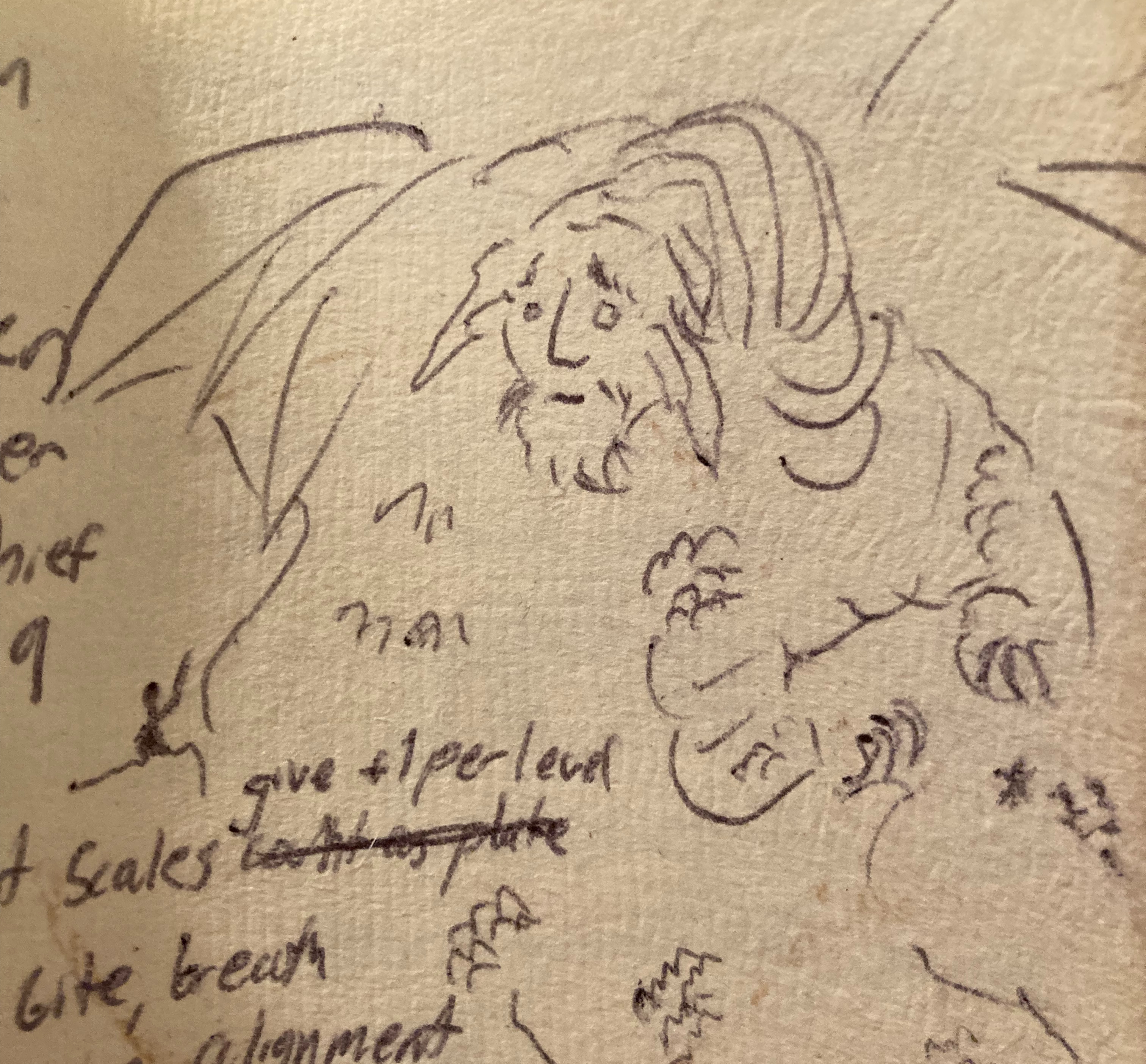 |
| Self-portrait |
A. Choose Special Monsters
A d6 encounter table is the right size. If you're putting several blocks together you may want to make different tables for different parts of the dungeon, but a d6 table is good because it allows for variety while repeating enough to give a sense of place. You should select creatures that you find interesting, not just creatures you think can serve a particular role. Putting goblins on your encounter table because you need a weak enemy is not likely to be as compelling as putting goblins on your encounter table because you read Goblin Market and got scared of goblins. One good way to find monsters is to look through your book's bestiary for creatures you like but haven't used before. (I did this for Little Snake's Man's Cave and got to use all of them together!) Another good way is to shut all books and think of intuitive, evocative freaks.
Of your six encounters, (and these will overlap):
- 2-6 able to communicate.
- 3-6 strategy or ability in combat besides repeatedly hitting a target. An alternate attack that makes you save vs something horrible is good. Lifting up a puny mortal by the foot is good. Throwing your coinpurse and running immediately is good.
- 1-2 Undead, if your game has something like a standard cleric class.
- 1+ creature of a type relevant to a major class ability, like a large opponent if your hobbit class gets a bonus against tall guys.
- 1-3 includes creatures you can't readily stab to death, either immune to attacks like a stone tiger or disparate like a swarm of rats or a glob of goo.
- 1 humanoid if none of the others are, or 1 non-humanoid if all the others are.
It is permissible for creatures of the same type to fill multiple entries on the table, if they're differentiated in some way. Mixed groups of creatures are encouraged, and if at least one creature in a group has one of the traits above, it "counts" for stocking your table.
 |
| The Derro. I wanted to put this monster at the top but then people looking at the preview on Discord would have to see it and that seemed rude. |
B. Choose a Scenario
Good dungeon situations are simple. They contain some fantastical element and involve some ongoing or recent event that makes the area relevant to those outside the dungeon. A remote fishery operated by a lich's dead automata and his crabfolk allies is an interesting place, but make sure they're affecting the outside world. Maybe they're selling cursed crab cakes or robbing the graves of nearby villages for workers.
Some fantasy media will be bad inspiration for a dungeon scenario because it will be saccharine and abstracted. All art forms have their gems, but there is a proliferation of ungrounded tabletop games drawing from bland video games drawing from uninspired movies drawing from misunderstandings of esoteric tabletop games drawing from commercialized short stories based on surface-level understandings of myth grounded in a fertile real-world storytelling culture. There is a reason almost every culture tells stories of betrayal, wonder, love, war, infidelity, dead people speaking, house spirits, and miracle workers. Try to tap into ideas that still have some juice in them. They don't need to be original but they should be exciting and emotionally grounded. If you're working in a setting inspired by Grimm fairy tales, you don't need to settle for reading TVTropes synopses or watching Neverafter-- Grimm tales are very accessible! Such is true for the many classic and/or children's and/or folk stories that are liable to have a lot of creative juice worth squeezing.
This is the time to decide some general features of the dungeon space. Unless otherwise noted, what are the doors, walls, and ceiling like? What do the doors look like? What smells prevail? List your assumptions.
 |
| from the Ouroboros of the Orb Oracle |
Spriggan's Den gives us the proportions for an 18-room dungeon thus:
- 3x monster with treasure
- 3x monster
- 1x trap with treasure
- 2x trap
- 3x special
- 1x hidden treasure
- 5x empty
Our dungeon is going to be 20 areas, or built in 20-area blocks, so you decide which of these categories you're going to have extra of, based on the kind of scenario you've chosen. My megadungeon Coyce includes a slight bias towards traps (having 3x) and special areas (having 4x). Often the character of the dungeon will have crystalized in your head by this step, but if not my standard advice would be to add +1 monster with treasure and +1 empty area. Later when we decide how to allocate treasure this means the spoils are more spread out, not necessarily that there is more of it.
The Basic Rules stocking procedure doesn't list everything that you'll want in a dungeon.
I recommend including the following:
- stuck door
- locked door (possibly with a key to be found elsewhere)
- two or more secret doors
- magic scroll (in games where magic-users learn spells this way)
- construction trick (like a sliding wall or imperceptible slope)
- text in uncommon language
- two or more descents/ascents of one or more levels
- poison (deployed via trap or enemy)
- disease vector
- effect that changes primary attributes
- effect that can change PCs in a unique, indefinite way
When stocking a dungeon space, I tend to refer to each "room" as an "area", as that helps to remind me that these are points of interest which may not be an enclosed cell. A large room might have two areas in it if there is some other natural border, and you should feel free to designate areas in the outdoors around the dungeon as relevant areas. Every area within the dungeon space should be keyed somehow, even if it's just as an empty room. This includes hallways and stairways that aren't contained in another area.
Since we haven't drawn the map yet, don't give exact dimensions. Each area should be defined by its contents and sensory details. If something is hidden, it should be hidden by something else a player might decide to investigate. Keep an eye to "enrichment"-- simple obstacles and things to interact with keep people engaged.
Areas with keyed monsters can draw from the random encounter table. If there are intelligent creatures here, where is their camp or the center of their community? If there are animals here, where do they den? Keyed monster areas are good places to put powerful creatures, since players can plan around the most dangerous creatures in an area better when they have a good idea of where they are. Keyed monster areas are also a good space for "choreographed" fighting spaces. Perhaps the monsters have built a fortification or trap, or perhaps they're at ease in an area and can't fight with their usual armaments or preparations. These can also be good opportunities to encounter dungeon denizens at peace, perhaps an old dependent or camp followers who aren't interested in fighting.
Areas with keyed treasure should take measures to ensure the treasure feels weighty. If there are coins, they should be heaping. I've seen dungeons where some big object is gilded and PCs are almost invited to scrape the gold leaf off as a treasure, but this is a big missed opportunity. By all means, make treasures difficult and time-consuming to acquire, but don't make it tawdry. Better to have a golden statue that is tricky to extract, or a locked chest that certainly contains coins. Treasure can also take the form of tools and valuable objects, but they should still feel special. It can be possible to include too many magic items, but it's no fun to have too few. I recommend one or two major objects, a spell scroll or spellbook, and a generous helping of very minor or consumable magic items. Against detractors, objects that give flat numerical bonuses, like the +1 sword, can be very cool if invented with lurid and savory description. This is more true in games like basic D&D, where small bonuses are rare and potent. In Pathfinder games it may be harder. Beware magic items that negate problems, but love magic items that help to solve problems in new ways.

The overall value of treasure in a 20-block section, not counting magic items, should be commensurate with the danger of the space. In basic D&D, you can pick a presumed character level, multiply the amount of XP that is needed to achieve that level from the previous for a fighter, multiply it by four, and add a little on top. So for a "first-level" dungeon block, that's 2000 x 4 = 8000 + a bit extra for 10,000 gold coins. To achieve the "heaping treasure" effect, it makes sense to put the biggest hoards in dangerous or remote areas. Pair smaller hoards with cool magic items or keep them in small forms, and give them some detail. A ring or emerald worth 10 gold found in an old tin among 100 old silver coins is much cooler than finding 20 gold coins on the floor. Wrenching a 6-gp gold tooth out of the mouth of the sorcerer who just shot at you with his Wand of Cut In Half is just icing on the cake of getting your hands on the wand. Remember, life is short and XP progression is quadratic-- be generous with gold in gold-for-XP systems.
Areas with keyed traps want other details to hide them. Players should have the chance to preempt danger and interact with a trapped area carefully, but it's too easy if the trap is the only object in the room. Lay a carpet in the middle of an empty cell and a careful PC will tug it away. Put a cabinet full of decorative spoons on the other side and they may step onto the carpet and fall down a chute. It's important to have a good idea of what triggers a trap and how PCs can interact with its workings, but it's also important to have some fun with it. Grandiose traps are fun, and whenever you include a simple dart trap or pitfall it's worth asking yourself if you can give it some pizazz, even if it's just a magic mouth that yells "You fucked up!" when the swinging blades shoot out.
Keyed special areas are a very good opportunity for the "effect that can change PCs in a unique, indefinite way" mentioned above. These could be delivered unwittingly, as in a trap or cursed object, or offered as an option, either by an NPC or some environmental storytelling. Other good uses of special areas include those that give more information, such as a market or library. I like to include a strange merchant in many of my dungeons. If you can, think of some really crazy ideas for what can be in your dungeon, then see if you can bear to put any in. Any good puzzles you have are acceptable. A lot of standard advice for special rooms include things which can be considered traps or else features that are worth including but sort of feel like wasted uses of the keyed area. By all means include graffiti, secret teleport traps, murals, upside-down rooms, saunas, and landmarks. Include them as features of other areas.
Keyed empty areas are never truly empty. They're just empty of monsters, traps, treasures, and special things. It's good if these contain some obstacle, or something to interact with. A well-stocked kitchen would be a good empty room. PCs might spend a lot of time there, and might use a bag of salt they find to slay an evil goo later that day. Empty rooms might convey information in the form of graffiti or spoor, or by overlooking other dungeon areas. If you want to include an area to characterize the dungeon but you don't have a good idea for it, it could be a good empty room. Like if you wanted to have a spooky torture chamber but can't think of anything more interesting to put in it than the standard black-hooded-guy whipping a dwarf, may as well just include it as an empty, transitional space.
An important tip for any kind of area-- don't forget that these dungeon tropes reference real and literary things. Think about how exciting it is to find a hidden area in your favorite Zelda game, or to see characters discover a secret passage in a film. This method involves checking off a lot of boxes, but the content of your dungeon space shouldn't feel rote. Outside of an adventure game context, deathtraps are cool! Glittering piles of gold are cool! A goblin is scary! Never lose sight of that. Incorporate it into the game.
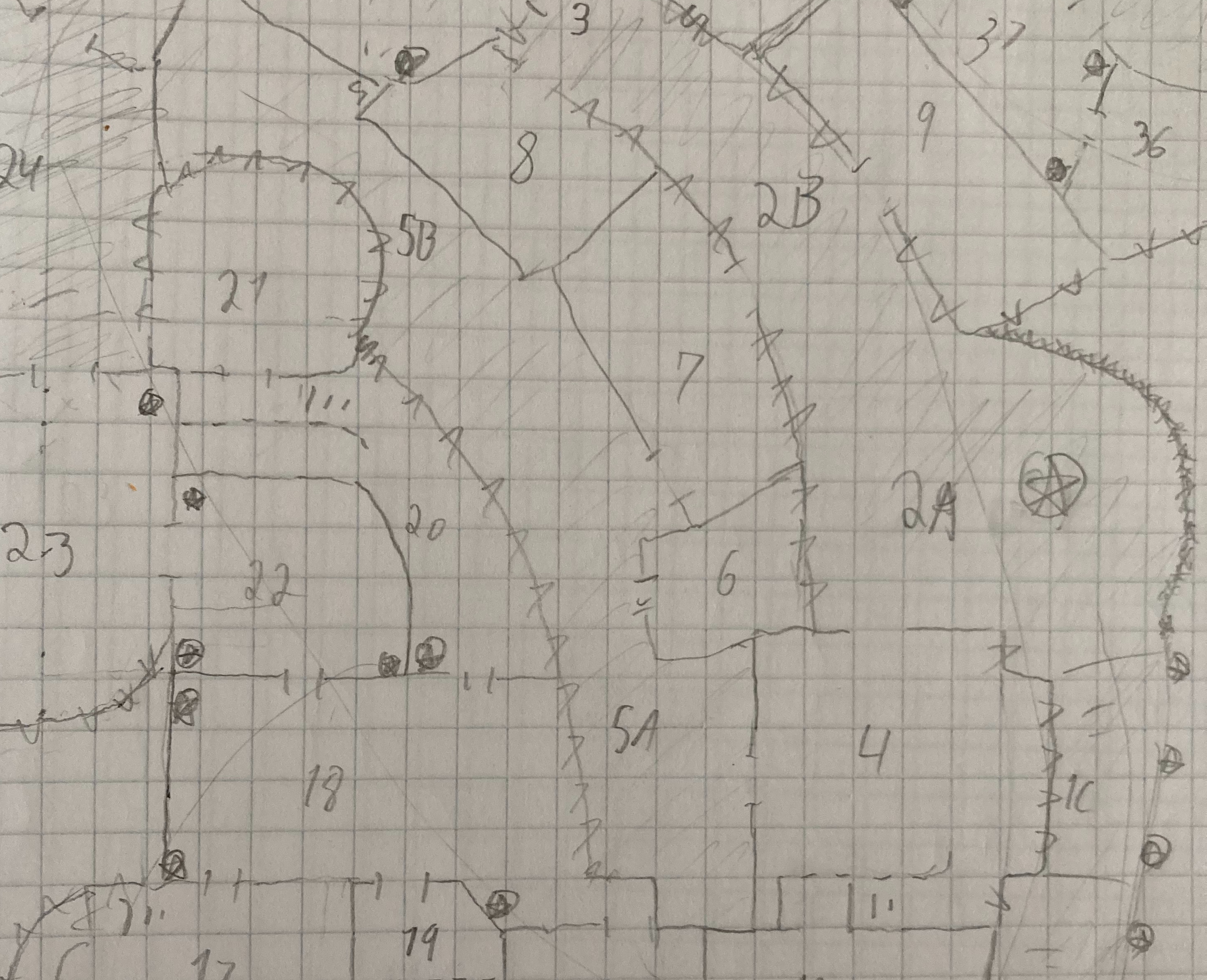 |
| It doesn't need to look good. Its beauty is its function. |
D. Draw the Map
First, draw three or more intersecting circles lightly on a piece of graph paper. This is the general shape the routes between the areas of your dungeon will follow, which is a simple way to ensure they will have sufficient loops and jacquaysion. If you deviate from this outline, that's fine.
Then, start blocking out the twenty areas in whatever way you choose, keeping in mind the areas you wanted to serve as dungeon entrances, the ones you wanted to be further back, etc. Try to keep room shapes simple for ease of description later. I like to stick to rectangles and circles unless there's some reason to deviate. One cool trick to watch out for is to see if you can create symmetries or patterns. Players might be able to pick up on these to help navigate, possibly even finding a hidden area. Use secret doors and hidden passages to conceal small and interesting areas or to provide quick routes throughout the dungeon, but don't fully cut off a large section of the dungeon behind one.
For naturally-formed dungeon spaces like cave systems, it's perfectly fine to draw each chamber with a simpler perimeter than it might have in real life. Make sure to pinch the connections between natural chambers, perhaps to doorway size, to avoid the issue of PCs entering one area and getting visual descriptions of too many things at once.
You may have to reorder the numbering for your keyed areas, but with only 20 that shouldn't be too hard. For your own ease, try to number the areas so a party proceeding through a loop will cause you the minimum amount of page flipping or scrolling. If one area is a dead-end or branch off a main loop, it's usually better to number that branch, then the rest of the loop. Whatever happens, it will be impossible to avoid some jumps because you designed a dungeon with loops and double-backs, and that's fine. Other than numbers, consider if there are any notes that really belong on the map. I might put a little x in a square if the exact spot where a trap is matters, or some other symbol to help orient myself when interpreting an area's description.
E. Finishing Touches
A 20-area dungeon is a perfectly good size to me but this method can also string multiple blocks of dungeon together. The megadungeon Coyce is made up of multiple levels of two or three blocks each, every new level possessing its own encounter table. If you do string blocks together, it can be fun to establish extra minor motifs when stocking the dungeon. For instance, at least one empty area in each block of Coyce has signage of some kind, at least one trap area and one empty area has a lever of some kind. Little touches like these can help the whole dungeon hang together.
Note that if made as I suggest, even a single block dungeon will have descents and ascents to different levels. This engages the third dimension and lets you do fun thinks like creating secret doors in a ceiling chute or pitfalls that lead to monster-infested quarters, but if inconvenient to your mapping preferences they can be ignored.
If you haven't already, come up with a cool name for your dungeon area and think about what PCs might learn about it. Fun rumors hint at the contents of the dungeon or will lead the players to make choices they wouldn't otherwise make. A rumor is bad if it has no effect and isn't even funny.
You are ready for A D V E N T U R E !
Thursday, March 2, 2023
30 Magic Items of the Prairie Traveler
Have been reading through the Prairie Traveler again as inspiration for the Americacrawl. I think I'd like to one day review the book for RPG purposes. Until then, some magic items based on the recommended gear for crossing the American west:
- Dwarven Flannel Overshirt: +500 coins of carrying capacity by some unknown means. Can be cleaned without water.
- Woolen Socks of the Wizard: itches in the presence of a newly-encountered magic-user
- Thickened Cotton Socks: Automatically pass saves incurred by ambushing creatures
- 1d4 Colorful Silk Handkerchiefs: Chirps and waves. Cough into it to reroll a death save. Pass or fail, the handkerchief discolors, shrivels, and dies.
- Devil's Own Shoes: On a forced march, gain a demonic aspect, +2 strength and constitution, -2 wisdom and charisma until you spend a day in rest. Heal 1d6 HP. Footprints are hooves.
- Levering Boots: When riding a warhorse, any melee weapon counts as a "charge" weapon, dealing double damage when your mount moves at least 60 feet.
- Nelson's Towel: regardless of what wets it, when you squeeze it out you get rum. Navy blue. The towel smells like blood but the rum flows clean.
- Inferno Poncho: pyrophobic gutta pecha poncho of chequey black and brown squares. DR 5 to fire.
- Brimmed Felt Hat: faded shining sun design on the top. Deflects headshots, or can be held as a shield.
- Thousand-Tooth Comb: twisting bug design. When placed on the ground, crawls towards someone whose hair is caught in its teeth.
- Noah's Brush: confers 1d12 intelligence on an animal for 1d12 hours.
- Masticurge's Tooth-Brush: casts Light twice a day, but only on teeth.
- Toledo Bar Soap: Clothing washed with this soap conceals those wearing it from scent-based tracking. Wax-yellow soap stamped with the symbol of an Ohio-based magician.
- Madrid Castile Soap: confers a fresh scent-- +1 charisma and wisdom until you draw a weapon. Ivory-white soap stamped with the symbol of a hoity-toity Spanish enchantress.
- Shrieker Whetstone: Instead of sharpening blades, darkens them to invisibility in the right conditions. Confers a +2 to hit in conditions dim enough to give a penalty to fighting. 4d4 uses before it dulls too much. Half grey, half dark red.
- Cascadian Coat: dark green canvas. When swimming or in the rain, double speed and can safely jump 20 feet.
- Vulcan Overcoat: coal-black denim, lining filled with ash from the Pittsburg dragon forge. Light as leather armor, protects like chainmail, well-pocketed.
- Green-Glass Spectacles: overcomes blinding effects, save true darkness. Elven wire frames prove resilient.
- Magic Blanket: wrap yourself up like a burrito and call out the name of a place the blanket has been before, and the blanket will float up to chest height and carry you there. Clumsy, but jogging-speed and tireless. Uncover your head to peek and you'll crash to the ground
- 1d6 strips of Blessed Buckskin: With a half-decent awl can repair damn-near anything. When used on mortal wounds, heals 1d6 HP.
- Grim-Hair Saddle: furry, worn, and thin. Mount has the stats of a dire wolf.
- 2d3 drops of Golden Goose Grease: food cooked with this grease refreshes you so you can go another day without resting. One drop is enough for a small group.
- Living Lariat: Expressive. Willing to swim across rivers like a water snake to help its owner ford them. Said to be knotted by Pecos Bill.
- Marching Wrought-Iron Kettle: follows owner on a tripod and cooks on its own.
- Henry's Mallet: Drives home pins, stakes, and pitons with a single tap.
- Bottle of 2d10 Magic Matches: burns quick and hot, but doesn't burn people or manufactured objects.
- Wrought-Iron Map Mess Pan: bread baked in this pan forms a topographic map of the hex in its crust.
- 3d4 Blue Mass Pills: save vs devices or halve constitution for the day and become magnetic.
- Tin Bucket: repairs itself, and can be used as a janky helmet.
- Bat Knight's Bridle: mount gains 60' darkvision.
Subscribe to:
Comments (Atom)