Sunday, May 10, 2020

GLOG Fighter Discipline: the Swordwife

Another quick entry into the list of fighter disciplines. This one is fairly straightforward, but leans into the bronze age setting I run. in many settings, the sword is the default weapon, but on the savannah of Holy Selmat or the heath of Mesomergos, it is notable in itself. This discipline also has its own built-in collecting minigame, as players try to gather interesting materials to alloy weapons with at level three. I imagine at that point a character might be carrying several weapons-- a main weapon, a backup, some effective against specific foes, and phosphorus daggers to act as magical torches.
art by Christian Sloan Hall
-SWORDWIFE-
Dedicated to the study of combat, you take violent work as a means of developing your skill. You seldom have the clarity to realize that your relationship with your sword is more important than your relationship with any other person.


Starting equipment: a khopesh or grip-tongue sword, a mattock, a hemione with a lead (treat as a donkey that can carry 2 less equipment slots)
Starting ken: artifice

A: Desperate dodge, Find the opening
B: Bronze tongue
C: Alloy
D: 'Til death do we part

Desperate dodge: Once per combat, you may drop 1d4 items to negate the damage of an incoming attack. These items are randomly selected from among what you are carrying, other than your held weapon and any armor. If you do not have enough items to drop, you fail to dodge.

Find the opening: When attacking foes who attacked you on their turn, deal +1d6 damage and choose whether to strike against their block or dodge score.

Bronze tongue: you can speak with metal weapons of all types, and have a natural affinity with all blades. 

Alloy: You can freely mix multiple different substances in any weapon you forge or reforge, gaining new abilities with each. For each substance beyond what is typical, your weapon gains a point of brittleness. Upon rolling a 20 to make an attack roll with the weapon, it is shattered. For each further point of brittleness, this range increases by one. If you can collect all of the weapon’s pieces, it can be reforged.

Example alloy substances and effects:
  1. Aluminum: weapon can be folded, taking up half the usual inventory slots.
  2. Antimony: you have this weapon with you in all dreams and visions.
  3. Arsenic: target rolls with a +1 on all injury rolls per arsenic strike.
  4. Bismuth: weapon as reflective as a mirror
  5. Bone: +2 to maneuvers used to sunder.
  6. Gold: +1d6 damage against ordena.
  7. Gigre particulate: +1 to hit while under the effects of drugs
  8. Iron: as iron, but requires 1/3 the usual amount of metal.*
  9. Lead: takes up an extra inventory slot. Target saves or takes 1 fatigue.
  10. Mercury: a day later, target tests their constitution or suffers from madness.
  11. Mithril: as mithril, but requires 1/3 the usual amount of metal.*
  12. Phosphorus: weapon now glows in the dark, as a torch.
  13. Silver: +1d6 damage against werewolves and preskeletons.
  14. Zinc: no longer naturally tarnishes


'Til death do we part: As long as you are holding a sword of your own power, you may ignore fatal wounds.

--------------------------------------------------
*Mithril can cut through anything softer than iron, which is somehow remarkably strong. Iron can do likewise, and severs the soul of all it kills.

Monday, May 4, 2020

Inherent Conflict in Mesomergos

An RPG setting should feel always on the brink of some great change, ideally several. While Mesomergos is influenced by German and Chinese bronze ages, I also want to bring the political turmoil of Weimar Germany, Warring States China, and the dolorous times of Arthuriana.
Urnfield culture group. Illustrated by Angus McBride

The political base of Mesomergos is the Palatial system. Petty kings and queens called Oathkeepers keep palaces as centers for importing supplies and surround their cities with farmers to keep from starving. This is kind of feudal but also totally desperate. Farming requires a knowledge of weather and communion with land that I will consider basically magical. Tradition, more than law, keeps order.


Tradition is breaking down. Every inhabited area has its own privileged partisan group, with several invisibly waiting to supplant them. It is assumed that every partisan group is at war with every other partisan group, and occasionally riots against the authority of the local Oathkeeper.

There used to be an emperor who commanded seemingly endless officers of the peace, but that time has passed. There are no police or soldiers in Mesomergos. That means no "city guard" groups to segregate NPCs into the combatant and non-combatant role. Every able-bodied person is expected to contribute to the peace of the land.

If someone violates an Oathkeeper's laws or a community's standard, it is up to one of three groups to bring justice:


  1. the members of that community, subject to the partisan justice of the local partisan group
  2. one of the Oathkeeper's martial servants, called a Sworn. There might be twenty of these per city.
  3. the Brotherhood of Messengers, whose claim to enforcing justice is incidental to their ability to reliably travel.
Knight Lady by Brooks Kim

The many gods of this world are tutelary gods, but none have claimed dominion of this marginal borderland. Still, gods are worshiped here and through the use of gigre, moral commandments compound. Those who slay a host after sharing wine with them incur the wrath of gods, no matter how pressing or how good their reason may be.


Social roles are likewise restrictive. Men cover their face; women never do. The harsh enforcement of role and place push people to make impossible decisions when the simple traditional law conflicts with mortal realities. Generally, those in power fail to reckon with the differences between people, whether it is the fundamental distance of species or the myriad minds of variety in ability and expression. Children become adults when they choose to cover or bare their faces, and this decision will affect marriage and prospects. Lepers and eunuchs are ostracized, even as they sustain vital social roles. Golems are exploited for labor and divergently-minded folk deemed defective. It is a system with no designer, unlike our own world in many ways but alike in caprice.

Foreign factions disdain the exertion of governing Mesomergos but are constantly obliged to intervene in its affairs, all to protect the vital flow of resources through its twin rivers. The seat of the emperor is broken, and no puppets can be raised to replace him while the land roils with curse and tumult. So they prevail upon their neighbors at the edge of Mesomergos to keep the minerals flowing, with veiled threat of force.

Where mortals seldom go, goblins hide. These creatures-- faeries, fey, gnomes, sprites-- follow a strange law of promise and word. They embrace the goblin dichotomy of Labyrinth, in which a goblin can be a hideous puppet or a David Bowie. Their uniting feature is that their power comes from their adherence to otherworldly rules. The success or failure in facing the gremlin is the ability to understand and turn back these rules.


by thorxoxlarsen on instagram

The Sworn

All of this explains why, in cursed times such as these, civilization will barely extend past the walls of a city. The seat of the Emperor was a foreign-created position, the product of wealthier lands which needed to lend the force needed to centralize power. An army is a levy of people you can't afford to lose-- farmers, shepherds, loggers-- led by your family and guard. But you rely on foreign goods-- vitally, your redsmiths need copper from the west and tin from the east. How can an Oathkeeper cut through the obvious Mandate of Hell that all must fall to ruin?

The default assumption of a game set in Mesomergos is that the PCs are Sworn, at least nominally in service to some Oathkeeper. This is a social role, and it also implies that they know enough about wildcraft to hunt for food, make camps, and make fire-- a rare skill in Mesomergos. Sworn come from all walks of life and can plausibly belong to any class or race. They are defined by their ability and willingness to go on quests, which gives a ready excuse for many kinds of adventure. It also brings them into contact with the highest of the high and the lowest of the low, embedding them in the social structure and creating great opportunities to roleplay as participants in society, whose capacity for violence is tempered by their duty.

The impossibility of Following the Rules is the main theme of Mesomergos, reinforced at every point. Any scenario can come to the pinch where a PC Must do two incompatible things, and they struggle to figure out a way to avoid their fate. It puts the onus on them to solve a problem and often incur some terrible penalty.


UNAROST

Saturday, May 2, 2020

Animals are Great

Among myriad monsters, gnomes, gnolls, scylla, and spectres, I sometimes overlook the effect mundane (or semi-mundane) animals can have in gaming. The same myth and folklore that spawned many of the iconic creatures given a central role at many tables is also flush with animals-- talking wolves, pious lambs, odd-limbed birds, and fantastic beasts with no obviously magical capability at all.

I think part of the reason animals are so infrequently used in RPGs is that they make for poor random encounters. Most animals flee when noticed, and if they attack they usually lack interesting things to do in combat. Because they are unintelligent, they make straightforward decisions. They do not speak your language.

But animals are great! Rather than acting as combat encounters, animals create environmental challenges. If players know how what a dog is like, they can interact with a dog in a meaningful way. A locked door can be picked or broken down. A guard dog can be killed, snuck past, bribed with sausage, taught the meaning of friendship, let loose to wander, etc.

Animal ecology can also create information about an area. Ants marching into a small hole might give a clue about a secret door. A bird in a dungeon hallway might suggest access to the surface. A bear implies its prey.

If a hostile area is primarily stocked with animals, you still want the players to have someone to talk to. Just let the animals talk; at least one. It's fun. It's almost a cheap trick. Nothing delights my players more than a talking animal. Is its personality stereotypical for its species? Hilarious. Is it against type? Still hilarious. Is it just a normal person? Somehow it's hilarious. You can't lose. Depending on the setting and genre, you can just let all the animals talk. If you want variety, I would use this:

d4 Animal Speech Capacity:
  1. no speech.
  2. Broken speech, a vocabulary of only a few words.
  3. Complete fluency in a language other than common. Draconic for lizards, thief's cant for raccoons, etc.
  4. Total fluency in common.
To demonstrate my thesis that animals are great, I will propose some scenes, details, and obstacles facilitated by animals in an adventure setting.
  1. A family of persistent beavers has flooded a section of the dungeon. tending a dam which threatens to disrupt an adjacent section.
  2. You desperately need some item at the far end of a bear cave. The titular bear is sleeping in the middle.
  3. A grove is covered in rotting apples, each riddled with burrowing wasps ready to respond to any movement. (This scene sponsored by my grandparents' old house.)
  4. A courtyard accesses several room in the dungeon, but is guarded by an aggressive rhino.
  5. Termites have rendered a section of a dungeon dangerously unstable.
  6. Dungeon denizens have trained cats to kill mice. They will go far out of their way to protect these cats in combat, and anywhere the cats cannot reach will be swarming with vermin.
  7. At dawn and dusk, bats flood the dungeon hallways, extinguishing lights and mucking up combats.
  8. Some crocodiles have learned to leave bait to trap their natural prey. For the dungeon croc, this bait includes coins, rolled-up scrolls, and potion vials.
  9. The password to enter the deeper dungeon is written on the underside of a wandering turtle.
  10. Wherever blood flows, swarms of flies are ready to cloud the room.
  11. Wherever bread is broken, swarms of locusts are ready to cloud the room.
  12. This underwater section opens to the ocean, and is lit by deadly men-o-war
  13. Since these dungeon denizens are immune to frog poison, dart frogs litter their living areas.
  14. Some maniac just threw a rattlesnake in a treasure chest and called it a day.
  15. a bee hive has formed in the mechanisms of this dungeon puzzle. Activating it will crush the hive and bring down their wrath.
  16. The moat is filled with completely mundane leeches, which will keep you from regaining health while undiscovered.
  17. Your foe stands confidently atop an elephant, which is plainly afraid.
  18. Hyenas follow you, waiting to feast on anyone you slay. They will alert dungeon denizens if bored.
  19. Climbing a chimney is frustrated by territorial cliff-nesting birds.
  20. You suspect a vital item was thrust into a weasel's den...

Saturday, April 25, 2020

There's a Zungeon in my Dungeon! d10 Seussian Loot


Dr. Seuss was a great poet and artist; let's mine his art for game ideas.

d10 Seussian Loot:

  1. Key Slapping Slippard: put this small creature in any lock and it will dutifully slap any keys away, effectively sticking the door. Killing a slippard brings down a terrible curse.
  2. "Happy Fingers" Cap: this garish cap has a plastic hand glue to the top. While wearing it, control it with full range of motion.
  3. Ooblek: a magical glue that falls from the sky. Wizards can probably make this somehow.
  4. Thing Box: Twice a day, summon a loyal but madcap servant.
  5. Thneed: an item all adventurers need. Can change shape to that of any mundane item worth 5 gp or less.
  6. Wocket: (or Wackpack or Wurlap sack or what have you.) This is a small creature that lives in your first equipment slot and gives advice if you are friendly. Give it a random skill from below:
    1. dreaming
    2. geography
    3. cryptozoology
    4. green food preparation
    5. military strategy
  7. Tough-tufted Prickly Snick-Berry Switch: a one-handed weapon that also inflicts a point of fatigue with each hit.
  8. Triple-Sling Jigger: a wheeled apparatus that fires three beanstones at once.
  9. Jigger Rock-Snatchem: a wheeled apparatus that catches missiles and returns them to their sender as quickly as they are caught.
  10. The Kick-a-Poo Kid: a nuclear grenade capable of destroying countrysides. Does not penetrate border walls.

A Triple-Sling Jigger and Jigger Rock Snatchem
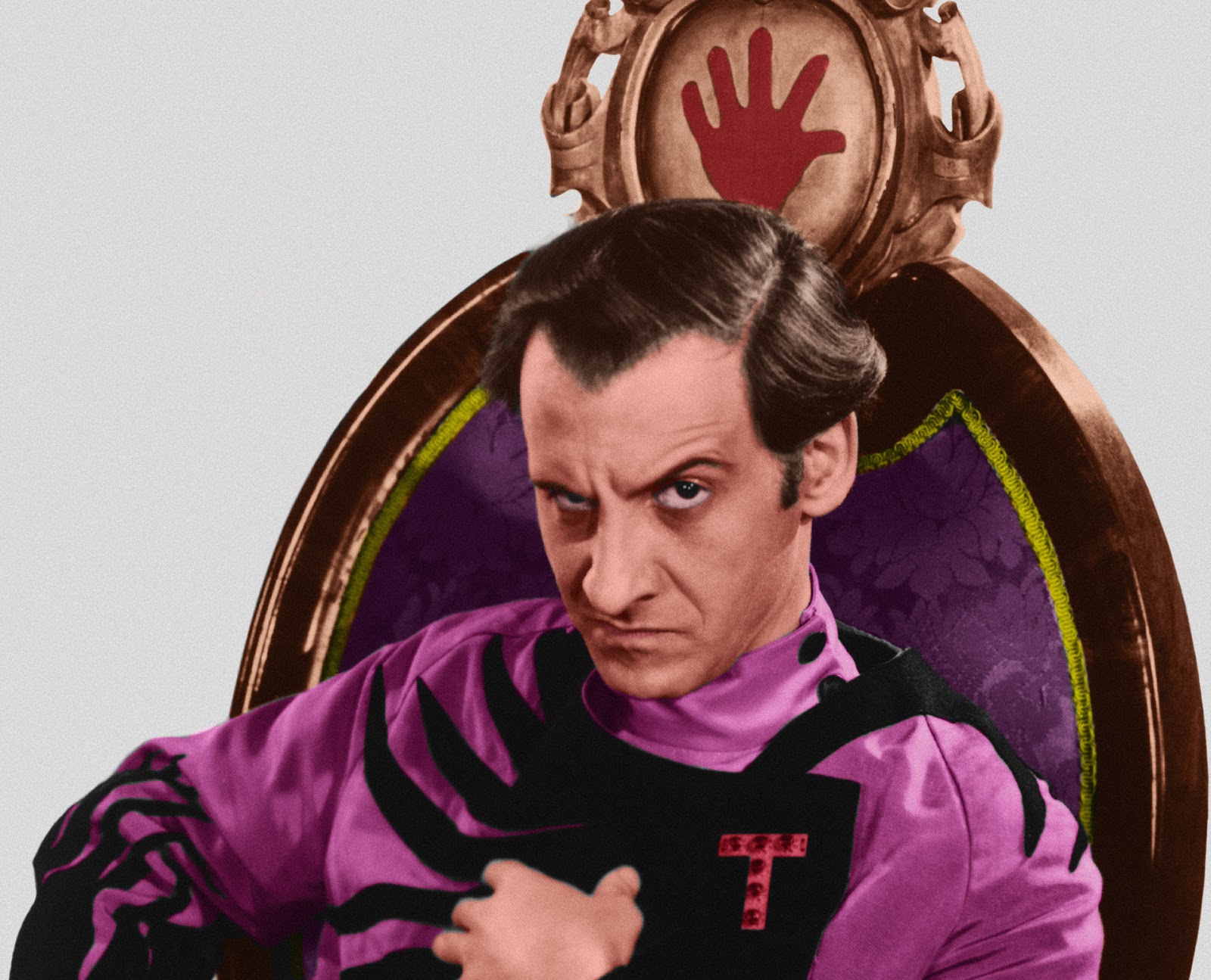
A note on the 5000 Fingers of Dr. T: this live-action film is essentially a ready-made dungeon populated by Dr. Seuss. The dungeon boss, a tyrannical piano teacher, has kidnapped five hundred boys to play a single, impossibly long piano. Complete with wandering monsters, dungeon guards, accoutremont, and several levels of torture chamber, I would love to see a play report set in the film.


Friday, April 24, 2020

GLOG: Architect Wizards

Who actually sets out to design a dungeon?
Alexander Brodsky

Architect Wizard
Suggested skill: architecture or mechanics


Perk: ARCHITECTURAL LETTERING. Anyone can use your spell scrolls without training.
Drawback: If you ever try to actually get work as an architect, you will get the strangest clients imaginable.


Cantrips:
  1. Drill
  2. Level
  3. Measure distance
Spells:

  1. Arcane lock (devise a riddle that must be solved to unlock a portal or container)
  2. Sympathy (two similar items borrow each other’s temperature, direction, or light. Strength of the bond increases with [dice].)
  3. Colorless Light
  4. Magic Mouth
  5. Flawless function (mechanism works without defect)
  6. Alarm
  7. Dig
  8. Speak with Devices (a device's intelligence is roughly equal to its complexity)
  9. Wardline (invisible line of magic that can be triggered and can exert slight force or activate a spell)
  10. Disassemble

Mishaps
  1. Spell die only return on a 1-2 for 24 hours.
  2. -3 to all tool checks, including armed attacks, for the encounter.
  3. Take 1d6 damage.
  4. For the rest of the day, you can only move in straight lines and right angles.
  5. The next blow a foe inflicts on you deals triple damage.
  6. The taunting muse of your masterpiece glimmers; cannot sleep until you spend eight hours (cumulatively) designing a dungeon.
 Dooms:
  1. All pages on your person shrivel. You cannot regain burnt die for 24 hours.
  2. From now on, casting a spell requires the use of a tool (any tool) as a focus.
  3. The ground swallows you up into the dungeon dimension, where you are forced to fill out non-euclidean blueprints for eternity.