Tuesday, November 16, 2021

VtM Revised: PC generator, Immortal relationship generator, vampire scheme generator, Chicago event generator

 I've been playing some Vampire: the Masquerade, and it's struck me that there seems to be a paucity of online tools to aid Storytellers. To make things easier for myself and for anyone else who might find it helpful, I've employed Spwack's html table tool to make some easy random generators.

First, a PC generator. It includes all the Camarilla and Sabat clans from the core rulebook, with page references. I did not exercise any influence on the distribution of points, except that I made it impossible to spread out abilities beyond what I can imagine players wanting to do. Merits and Flaws are included in their own separate generator, and always balance each other out, which you can tweak as desired.


Next, the immortal relationship generator, to characterize the centuries-long personal history of vampires and other undying beings. To establish a relationship, designate two characters and hit the generate button. If they've been around for only a few decades, use "modern nights" to establish the two main events in their relationship and how they feel about it. For characters of an age typical of older vampires, include later entries. For example, the relationship between two 8th generation vampires would include the 8th, 9th, and all later generations through modern nights. If they are wise, they consider the entirety of their history in deciding how to feel about each other. Otherwise, they use knowledge picked up in ancient times but are only motivated by events of modern nights.


To aid in brainstorming, a vampire scheme generator. Decide whose scheme it is and who their target is, then hit the generate button to get the broad strokes of a plan to deploy against their victim.


This last one is probably only useful to me. It's a random encounter table for when the vampires of my chronicle go wandering the streets of Chicago.


Tuesday, November 2, 2021

15 Biome Encounter Tables

 I enjoy ecosystem-based encounter tables, but the very best are hard to find. They can be so broad as to lack any evocation of place, as with endless "forest" tables that list all the mainstay monsters, plus or minus a treant. I like to have many small regions of only a handful of hexes, which might put one plains next to another plains with an identical encounter table. What's more, it's hard to find meaningfully different biome-based encounter tables, since the most obvious choices are always included. If you're not including dire camels on your desert encounter table, where are you going to put it?

Here it pays to be more specific. Rather than a "forest" table, you can roll on an "elfy coniferous forest" table and get specific encounters with a better sense of their intentions, appearance, and accouterments. I beg the world to generate many small, specific encounter tables that can nevertheless be pressed into service for piecemeal hexmaps, hastily assembled two-shots, or inspiration for full adventures.

To that end, I've made fifteen d6 encounter tables for more specific biomes. I did this by randomly generating lots of 6 monsters from Old School Essentials without any attention paid to hit dice or typical environment, then designating the biome after the fact. This forced me to make creative decisions about why two unlike creatures would be found in the same place. Once I had the biomes named, I noted the number appearing according to OSE and invented example behavior for negative, neutral, and positive reaction rolls according to this format:

(negative/neutral/positive)

This step was important to me because I'm often stumped by uncharacteristic reaction rolls at the table and I though the work of brainstorming ahead of time was worthy, and also to further characterize the region.

Induction by Josh Pierce

As I worked on this project I noticed how useful some parts of the classic D&D monster write-ups were for this project. Number Appearing was constantly helpful (except when they were churlishly listed as "0",) as were any notes about a monster's affinities and hatreds. Behavior of any kind was often folded into one of the example reactions, and characteristic attacks let me vary even the negative reactions. Fighting to the death can be easily overdone in D&D, and I tried to give even chaotic or animal enemies some specific goal where appropriate.

If you want to extend the d6 tables, I recommend adding low-level creatures, since total randomness in monster selection makes the areas quite dangerous. (Remember, encountering dozens of humanoids likely means most are not patrolling with bardiches in hand.) A good template for extending into a d10 table might be:

7. 1-HD humanoids or wildlife
8. familiar faces (someone the party fled, helped, etc.)
9. 
rival adventuring party
10. Roll 1d6 twice and combine

Here are the 15 encounter tables, and a link to the OSE monster SRD to inspire your own:


Haunted War-torn Jungle
1. Bats! 75% 1d00 normal, 25% 1 giant bat. (attack and combust/size up/aid in hunting)
2. Squad of 2d6 Veterans (opposed alignment/deserters/ideologically aligned)
3. Elemental, lesser. 50% water, 50% fire. (punish/ignore/heal the land)
4. Haunting of 1d8 Spectres (attack armed humanoids/warn of war’s folly/lead to bodies and loot)
5. Dragon, green (flyby breath attack/accept tribute/offer task)
6. Crocodile. 75% normal, 20% large, 5% giant. (drag off weak victim/ignore/offer advice or a ride)

Degraded Pool-ridden Shore
1. Cloud of 3d12 Stirges emerge from a pool (dive attack/hover over pool/depart from corpses with loot)
2. Platoon of 4d6 Hobgoblins (capture for ransom/conscript/exchange information)
3. Pod of 1d3 Whales, sperm. May beach themselves. (emerge to swallow whole/swim by/disgorge cargo) 4. Herd of 1d10*10 Horses. (stampede/grazing on goosefoot/friendly tamers scoping out the best)
5. Jaunt of 2d6 Nobles, each with a squire and 1d10 fighter retainers. (covering up association with hobgoblins/enjoying a terrible beach day/hiring champions)
6. Pride of 1d4 Manticores (track and ambush those who stop to rest/defend nest/trade area knowledge for meat)

Corrupt Trading Coast
1. 1d2 Octopodes, Giant (grab d8 people and objects/observe from camouflage/offer watery trinket)
2. Platoon of 1d6+1*10 Dervishes. Mounted. Half are light lancers, a quarter are cataphracts, a quarter are archers. Dislike orcs. (capture as spoils/lecture and ask directions/engage in charity and personal improvement)
3. Invisible Stalker (ransack for clues about target/wildlife give away presence/make a kind connection)
4. Clump of 1d3 Caeciliae (swallow whole/guard hoard/acts like a friendly dog that doesn’t know its size)
5. Band of 1d6*10 Orcs. For every 20, there is a 1-in-6 chance of an ogre. Dislike dervishes (send night squad to rob/send junior members to challenge/trade rare goods)
6. Family of 1d4 Triceratopses (charge/skittish/curious)

Ancient Cave-ridden Plains
1. Hydra (stalk/seek out water/cuddle)
2. Hawks. 75% 1d6 normal, 25% 1d3 giant hawks.(swoop or abduct/inspect from afar/warns of a nearby cave)
3. Hunting Party of 1d6+1*10 Dervishes. Mounted. Half are light lancers, a quarter are cataphracts, a quarter are archers. (capture and escort out of the area/trade advice/ask for help hunting servants)
4. Pit of 1d6 Wyverns (ambush/lead to rival wyverns/throw gold at party to cover a getaway)
5. Pit of 1d6 Wyverns.(aggressive display/guard cave/offer shelter)
6. Crash of 1d6 Titanotheres (stampede/circle together/escort)

Alpine Pool Mountain
1. Expedition of 3d6 Traders with 1d6 mules. (pawn off boondoggles/sell furs and clothes/share brandy)
2. Party of 1d10 Thouls (Drive off/confiscate elves and fire supplies/trade for meat)
3. Clutter of 1d3 Spiders, Giant. Tarantellas. (ambush/block trail back with webs/inadvertently show treasures)
4. Grove of 1d6 Treants. Conifers. (drive off/chat/share magic sap)
5. Lounge of 1d6 Basilisks (attack in ostentatious display/watch from the shadows/give magical scales)
6. Community of 1d4*10 Neanderthals (throw rocks and shout/trade through gesture/offer hospitality)

Intertidal River Canyon
1. Wing of 2d8 Hippogriffs (prey upon/survey/befriend)
2. Herd of 1d10*10 Horses (stampede/migrating quickly past/paying homage to party and hippogriffs)
3. Coincidence of 1d10 Lizards, Giant. Stats as gecko. (bowl over/beg for food/lead to hiding place)
4. 1d2 Fish, Giant. Mudskipper, as catfish. (ambush from bank/guard shiny in the shallows/offer ride)
5. Cast of 1d6 Crabs, Giant (pinch apart/bar way/invite to rave)
6. Ambuscade of 5d8 Troglodytes (eat/bully into trades/offer roll in hippogriff hunt pageant)

Chimney Hill Caves
1. Hydra (oh shit this one breaths fire/reveal hidden cavern/mutely conscript in hobwar)
2. Convention of 4d6 Hobgoblins (arrest and interrogate/give directions to anywhere not nearby/demand fiery oration)
3. Clump of 1d3 Purple Worms (swallow whole/cut off backtracking/lead to underground destination)
4. Party of 1d10 Thouls (hunt/ask party to join in their hunt/join party for a time)
5. Pack of 2d10 Rats (engulf/flee/ask for help in tinny voice)
6. Scandal of 2d4 Harpies (charm and harm/insult/follow for scraps while gossiping)

Abandoned Forest Route
1. Noise of 1d6*10 Orcs. For every 20, there is a 1-in-6 chance of an ogre. (scare off/trade woodwork/send a trio to accompany party)
2. Wing of 2d8 Hippogriffs (carry off/shadow from overhead/beg meat of party)
3. Ambuscade of 5d8 Troglodytes (erupt from hollow to take captives/argue for a toll/conspire with party against orcs or lycanthropes)
4. Gelatinous Cube (pursue/run into/guard faithfully)
5. Pack of 1d6 Blink Dogs (drive off for unknown purpose/accept pets/lead to interesting site)
6. Misery of 2d6 Lycanthropes. Werewolves. (heavy silver toll by day, indoctrinate by night/brusquely trade/beg for compassion)

Occupied Ranging Plains
1. Mastication of 2d8 Ghouls (order party to secluded eating spot/bully/sell shoes, jewelry, and household supplies)
2. Platoon of 6d10 Goblins. 1-in-5 chance they ride wolves. (disappear someone/interrogate/allow you to offer them drinks)
3. Invisible Stalker (seeks party leader/eavesdrops and reports to master/insurgent sabotage)
4. Cavalcade of 2d10 Centaurs (sell out to the regime/beg for supplies/aid in daring missions)
5. Pit of 1d4 Snakes. Giant rattlers. (attack without warning/give warning/foreshadow secret resistance door knock)
6. Herd of 1d6 Titanotheres (stampede/graze wearily/conceal refugees tied underneath them)

Open Water Archipelago
1. Pod of 1d3 Whales, Sperm.(ram or swallow whole/wave as they pass/lead to another ship)
2. Swarm of 2d6 Robber Flies (ambush from shadows/build nest in side of ship/offers to fence goods)
3. Camp of 1d4  Leeches, Giant (suck dry/just a little taste/attack next encounter)
4. Wing of 2d8 Griffons (attack sails/flyby salute/mutely request medical aid)
5. 1d2 Octopodes, Giant. (drag sailors under/get caught in the rudder/trade shipwreck doubloons for treats)
6. Outfit of 1d4*10 Brigands. For every 20, there is an additional ship. (rob/seeking repairs/pay to say nothing of this to port authorities)

Stinking Enchanted Swamp
1. Bushel of 2d6 Ogres (crack skulls/scare off/invite to horrid supper)
2. Infection of 1d4 Yellow Moulds (inconvenient place/allow people to pass with care/reveals secret cache)
3. Jolt of 5d4 Bugbears (rough up/practical joke/invite to bawdy night out)
4. Span of 2d6 Mules (stubbornly rebuff/look on in dismay/cry out for help with human voices)
5. Slip of 1d4*10 Pixies (slit/lead astray/lead to boon)
6. Haunting of 1d6 Wraiths (scare away/twisted warning/offer boon for proper burial)

Moral Test Bayou
1. Fancy of 1d4 Chimerae (exemplify wickedness/exemplify diffidence/exemplify virtue)
2. Market of 6d10 Goblins. 1-in-5 chance they ride wolves. (force to eat unwholesome fruits/sell unwholesome fruits/trade like reasonable people)
3. Pack of 1d8 Unicorns (impale/flee/defend)
4. Camp of 1d4 Leeches, Giant (suck virtue/attacking peasants/offer to suck vices away)
5. Shiver of 3d6 Sharks, bull (circle before attack/follow waiting for wound/propound the virtue of wrath)
6. Empire of 1d4 Owl Bears (drive off/bicker among themselves/offer wisdom)

Overgrown Pilgrimage Battlegrounds
1. Churchyard of 1d6 Treants (rebuff intruders/demand test of conviction/enforce sanctuary)
2. Scandal of 2d4 Harpies (ruin/vandalize/repent)
3. Grey Ooze (ambush/attempt to recreate a saint’s statue/perform rites)
4. Wing of 2d8 Griffons (do battle/report troop movements centuries out of date/ask for help in their confusion)
5. Squad of 2d6 Veterans. (opposed faith/mercenaries/theologically aligned)
6. Sleuth of 3d10 Berserkers (non-consensual tests of strength/share bread with allies in faith/seek recruits)

Lake Canal Frontier
1. 1d2 Octopodes, Giant (abduct across water/offer wrestling match/escort)
2. Crew of 5d8 Dwarves (boss around/survey area for construction/share information near build site)
3. Band of 1d4*10 Brigands. Half are mounted. (rob/”invite” to expensive meal in the woods/gift arms and burglarious tools)
4. Pack of 1d6 Blink Dogs (presage accidents/beg food/accompany until they help with a disaster)
5. Dragon, sea (terrorize and steal/demand toll to continue/offer aid in destroying pesky monsters)
6. Shrieking of 1d8 Spectres (drive off/vandalize/request reuniting with living descendants)

Uncovered Swamp Ruins
1. Invisible Stalker (homicidal rage/guards a treasure/just really needs a friend right now)
2. Swarm of 2d6 Robber Flies (Bite with sleeping poison/buzz in warning/dance for onlookers)
3. Cell of 1d12 Mediums (ineptly attempt capture or enticement/perform baleful summoning/perform amusing tricks)
4. Elemental, lesser. Water elemental. (rage for ancient wrongs/weep for ancient wrongs/aid those who are still innocent)
5. Herd of 1d12 Pegasi (territorially defend area/struggle in the mire/offer ride)
6. Drove of 1d4 Gorgons (buck/graze on poison/follow out of domestic instinct)

Isolated Taiga March
1. Sleuth of 1d4 Bears, black (pursue ravenous hunger/laze about sleepily/show where to find sap)
2. Golem, wood (scare off/wandering among friends, offended by firewood/offer shelter)
3. Colony of 1d6 Vampires (charm and drain/invite to leaning wooden edifice/offer office and sign of protection)
4. Copse of 1d6 Dryads. Coniferous (entice into tree/hide despite evidence of activity/party hearty)
5. Herd of 2d8 Mastodons (stampede/pass warily/leave 1d2 valuable tusks)
6. Depot of 3d10 Bandits. Technically empowered by foreign power (press-gang/pay for supplies/invite to merriment and conspiracy)

Monday, October 25, 2021

Poetry in the World

I think people are pretty hungry for simple joys. We don't walk in the woods as often as we like, or eat a hunk of bread in flickering candlelight, or study the play of light on a stream, in a crystal, or in motes of dust in the air. We aren't hungry for woe and sorrow, but even those can affirm the meaningful and set our lives into focus compared to the cruel monotony that hums through work floors, grocery back rooms, kitchens not our own, and endless hallways in need of cleaning. 

Stories of adventure or horror or romance need these simple sensations to land. They need little beats of contemplation where the characters sing on the road or brush aside cobwebs or stare at a cluttered table while someone is away. Poetry can be helpful, but poetry is inane without a subject we can feel or sense. The way a sentiment like "she was tired from marching and the cheese tasted nice and the place by the fire was warm" is phrased may intensify the feeling if put well or weaken the feeling if put poorly, but even at its simplest these kinds of sentiments need their space in a story.

The sentiment does not need to be original. It does not need to be fresh. Bog-standard fantasy, say, is flush with the lush and lurid. It's easy to forget an old man with a long beard and pointed hat and stars-and-moons robe is a powerful image because it is familiar, but do not let it be forgotten. Put emotive intensity in the description, as though the sentiment was truly original! Have characters react to the strange! If all else fails, straight-up tell "the way he dresses is striking!" We are putting finite words into an infinite world and all performances are fleeting, ever-wearying. Editing is for now-right-now. 

Once you have the sentiment, give it action. The man's manner of dress is striking? He should say something striking, or light his pipe with an orc tooth. If you're on your game you can support the sentiment with second-order expressions. Maybe he expresses remorse that a more mundane character has been endangered by the otherworldly that the wizard represents. "I am sorry this has happened to you." How often do your characters seem unsure of themselves, or regretful or overconfident or melancholy? Maybe he's ashamed to be so weird?

So many stories are obsessed with what is happening in the moment. Between crises, we should have time to recall what happened last chapter, last session, last year. We should miss those who were lost and reflect on how we've changed.

So many stories are obsessed with what is happening in the moment. Between crises, we should have time to ponder what we will do once this current task is done. If we live long, how will we manage old age? What will we do with ourselves.

When the story is done, we should cherish the remainder. Study the book you just finished for a few minutes. Roleplaying games are great for this-- their ghosts lay across notebooks and sheets and maps, hopefully in sketches or little songs we wrote or in tables and generators waiting for new purpose.

Ask, for each story and each part:
What is beautiful?
What is strange?
What is missing?
What has changed?
What is meager?
What is great?
What is its evoked emotional state?

Saturday, October 16, 2021

Testing out Saltygoo's Fantasy Land Generator

 Salty Goo, of Gooed GLoG fame, recently produced a "Fantasy Land Generator". It describes a region by hex-size, biome, and notable features, as well as drawing from many bestiaries to suggest a couple of monsters one might encounter in the area. I decided to fire it up and quickly sketch out my own little fantasy land:

(I want to be clear that this is not necessarily the intended procedure, but I was intrigued by the possibility that it could be done. The regions were assigned arbitrarily, without much thought on my part. What follows are the descriptions as they were given to me, with no changes except some formatting.)

(Commentary in italics)

1. This five-hex forest is known for its colossal menhirs. Beware, for there are moss patches that were placed by lumberjacks in the area. It is inhabited by sacred Copperback Snakes, and also sacred Magpies.

Already a neat, inspiring hex. The menhirs and sacred animals seem like they'd be at odds with the lumberjacks, but maybe they have some kind of agreement. The only thing I'd struggle with if I generated this on the fly is the moss you must beware. Maybe it's spread to encourage tree growth but can cause some fantasy illness or ritual uncleanness.

2. This nine-hex cold region is known for its ice-covered power stones. Beware, for there are pagan idols that attract goblins in the area. It is inhabited by thunderous Cave Bears, and also winter-loving Blue Dracopedes.

This hex highlights two quirks of my method with Saltygoo's generator. By taking the first ten results, I might make a region that doesn't make sense next to other regions. This arctic waste is right next to cacti-covered hills in region 3. Another quirk is that there's a lot of obscure monsters in this generator, and I don't always want to look them up. 

3. This six-hex grassland is known for its fern-covered hills. Beware, for there are cacti that could make you trip in the area. It is inhabited by peaceful Starlings, and also migrating Cassowaries.

Weird. I would consider putting a secret feature here, so it seems benign when first encountered, then gains a new character later.

4. This six-hex swamp is known for its oozing remote tavern. Beware, for there are tangles of roots that are very painful in the area. It is inhabited by Calytaurs who hate all the gods and are obsessed with hygiene, and also clever Aqraseths.

"Oozing remote tavern" is not a winner for the random generator, but at least it has character. Maybe we'll reinterpret it as the home of alcoholic ooze beverages. Google tells me Calytaurs are pigmen, which is pretty delightful. An Aqraseths is a heron-croc dinosaur. This would be a cool place to put important guides, mercenaries, and hirelings, to help the players come up with reasons for their PCs interact with the godless pigmen. Getting past the unfamiliar monster names, this region rocks pretty hard actually.

5. This five-hex mountain range is known for its overflowing gas vents. Beware, for there are rivers that are treatcherous in the area. It is inhabited by diurnal Vultures, and also Airwalkers who offer training to whoever can race them.

(sic). Racing airwalkers is a fun encounter. Maybe the vultures use the gas vents as thermals? We should see them sometimes in nearby hexes, sometimes following a predator. This would be a great region to put a dungeon.

6. This five-hex jungle is known for its murky canopy. Beware, for there are peppers that are scalding hot in the area. It is inhabited by a Sorcerous Cabbal that agressively fights all trespassers, and also a Sorcerous Cabbal that agressively fights all trespassers.

(sic!) Love the rival cabals. The adventure hooks practically write themselves. Flesh them out and differentiate them barely. For economy of factions, we can feature the calytaurs and goblins from elsewhere in the cabals.

7. This six-hex jungle is known for its turquoise ponds. Beware, for there are nervous Parrots that could make you fall asleep in the area. It is inhabited by a sacred Basilisk, and also lumbering Dingoneks.

A lot of the random animals feel appropriate to medieval bestiaries. Parrots that make you fall asleep? Players will want one! They'll want to interact with them. The basilisk reminds me of the copperback snakes from region 1, so it gets to be a copperback basilisk. Dingoneks are apparently armored dinosaurs.

8. This five-hex swamp is known for its fern-covered thickets. Beware, for there are dying animals that could rot your food in the area. It is inhabited by Athachs who herd sheep while being manipulated by fairies, and also haunted Blindfire Vines.

Athachs are three-armed giants. Alright. Swamp sheep? Sure. I don't think this adds to much, but it's perfectly fine. The worst case is the party making small talk with a giant while they barter for food, then run into a carnivorous plant.

9. This hex holds a city known for its surveiled slaughterhouses. Beware of the corrupted officials that restrict movement there. Its streets are roamed by wizard-owned Animated Rugs, and also witchy Tressyms.

Back to kicking ass. Feels like a legalistic government whose scholars are primarily magicians. Maybe they surveil slaughterhouses because they fear blood sacrifice. Tressysms are flying cat familiars. This seems like a reasonable settlement to form a recurring base for PCs, and it has real character. If we're imaging this to be a border outpost it's odd, but we can lean into that. Maybe disgraced or underachieving members of a more frenetic magocracy are sent here? Maybe it's worth fleshing out other notable settlements so it doesn't feel like it sticks out. My at-the-table fix would be to emphasize how there's heaps of villages and towns around the city in the same hex.

10. This five-hex rocky land is known for its gravelly war camp. Beware, for there are hidden pit traps that could slow you down in the area. It is inhabited by Cyclopskins who tend to a primeval temple and are afraid of the sky and birds, and also Goblins who hide in tunnels and are organized like the mob.

Luckily, we mentioned that goblins were attracted to region 2. I guess this is where they come from! The standard interpretation is probably that the cyclopskins and goblins are forces of chaos massing to destroy the city of region 9, but we can imagine other dynamics. Maybe they want to make war on the sacred magpies of region 10, or seek the magical aid of the city's magicians. In any case, they have some pressure to apply to any road out of the city.

-

I want to run this! I want to drop in Harpyshaft and TotSK and Wild Man's Grave and make this a properly cozy sandbox. Keying with small regions feels very nice, and means I can fill in individual hexes as I desire. A milieu of pigmen and cyclopses and mages and various sacred birds and serpents. It's all random but with a little work could take on a solid identity with a considered theme.

Tuesday, October 12, 2021

Kastromancy: a Convenient Art (GLoGtober #3)

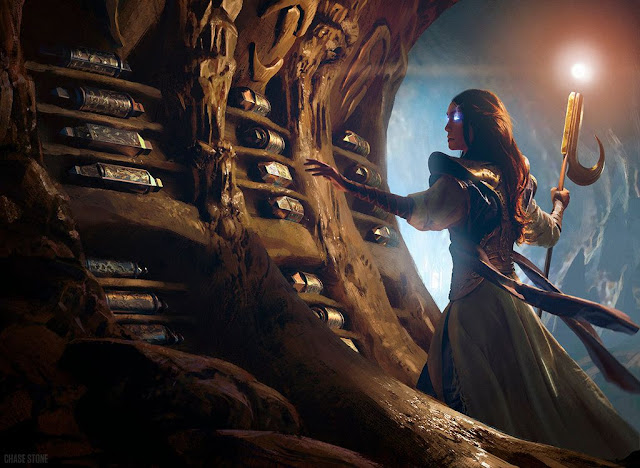
In a case of nominative determinism, this piece is by "Chase Stone"

Beloved one-page dungeon the Skyblind Spire includes a brief piece of lore-- the impossible architecture of the tower and the magic it generates is the result of "Kastromancy," apparently a discipline for discerning how to use strange layouts to create potent magical effects. This is an elegant inversion of the usual admonition of the "funhouse dungeon", which is that if the contents are fantastical, you shouldn't expect them to be laid out in a reasonable way.

Kastromancy can be extended to be more useful to gameplay. If a structure is applied to the foundation of the art, it can be employed by high-level magician PCs to build their own dungeon spaces, to understand dungeon master rivals, and to create valuable resources to seek out, destroy, refine, create, and treasure. 

Domain-level play through the establishment of keeps, construction of trade guilds, and nourishment of congregations is helped along by the basis normality of such things. They are real things, with countless examples in the real world. Domain-level magic, and magical projects generally, lack a real-world analogue. If a magical problem lacks a mundane solution, the magical solutions a player thinks of is only as good as the fictional magical framework established in the setting.

The two rudiments of kastromancy are physical room layout and kastromantic arrays, and they must work in tandem. Anything weird or "unrealistic" about dungeon layouts are a result of kastromantic principles-- octagonal rooms, gridism, 10-foot-wide doors. Most kastromancers find it easiest to arrange their lairs underground or in tall towers, where the base functions as a magical nexus. Students of the Convenient Art use random architecture oracles to discover new principles.

Kastromantic arrays are made of certain magically-resonant stones. Their type determines their general effect, while occlusions or details affects their expression and their cut affects how they can fit together in an array. A kastromancer may rejoice to find a heart-cut clouded fire opal, since it just fits so well with their tear-drop pure emerald in the strict mathematical edicts of their array diagrams.

A dungeon that has been sufficiently cleared out to be made safe can be thoroughly searched by a magician to sniff out where the array is held, buried at a central location or hidden in a clever chamber. It might have 1d4 stones for each level, plus one for each weird magical effect in the dungeon that must have come from kastromancy. If you're reading an old module that explains how a fountain was filled with ever-flowing acid due to a wish spell, this is likely the module author dutifully concealing the Convenient Art from mortals. Kastromatic stones are found in the possession of dungeon masters, on the wizard black market, or sometimes in the possession of mining and jeweling enterprises. Wizards generally try to keep the existence of kastromancy from mine-rowdies and industrialists for this reason.


General Shard Types

  1. Divination. Might let a dungeon master know when trespassers arrive, let them look around with disembodied eyes, or project their spirit as a massive glowing head to yell at rival adventuring parties.
  2. teleportation/impossible geometry. See the link to the Skyblind Spire above.
  3. impossible weight-bearing. Build ever-down, minimizing support structures, and last for countless ages.
  4. Pacts. Summons monstrous humanoids of various sorts. A one-time calling, but prevents normal turnover. The magician reliably knows what kind of group they are calling, but not the specific group or how long it will take them to arrive. Does not assure loyalty or prevent coups.
  5. Anti-gravity. Also anti-friction and other physics tricks.
  6. Shrinking/growing, and its remedy. Some allow for more terrible transformations, such as the famous "Dying Breath to Dire Boa" transformation.
  7. Preservation, either a temporal stasis or a reprieve from age.
  8. Haunting, soul capture, and spookums.
  9. Boundary stones. Keeps monstrous denizens in their assigned rooms.
  10. Bullshit antimagic. "Teleportation effects in the dungeon instead teleport the user to the elemental plane of fire." "All attempts to charm the statue make the caster permanently insane." "Speak with dead now makes you shit yourself and bite your tongue at the same time."