Showing posts with label magical theory. Show all posts

Tuesday, October 12, 2021

Kastromancy: a Convenient Art (GLoGtober #3)

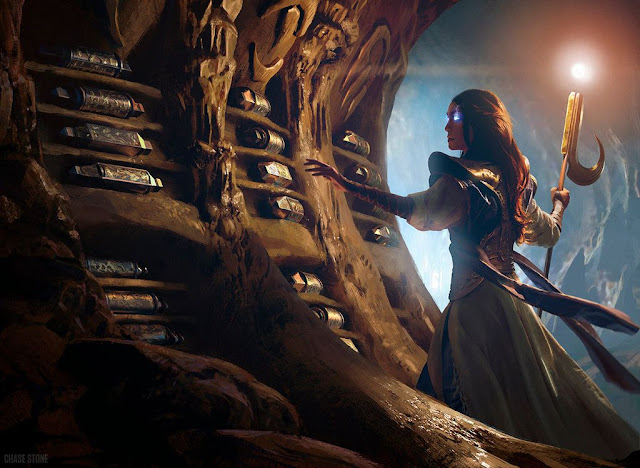
In a case of nominative determinism, this piece is by "Chase Stone"

Beloved one-page dungeon the Skyblind Spire includes a brief piece of lore-- the impossible architecture of the tower and the magic it generates is the result of "Kastromancy," apparently a discipline for discerning how to use strange layouts to create potent magical effects. This is an elegant inversion of the usual admonition of the "funhouse dungeon", which is that if the contents are fantastical, you shouldn't expect them to be laid out in a reasonable way.

Kastromancy can be extended to be more useful to gameplay. If a structure is applied to the foundation of the art, it can be employed by high-level magician PCs to build their own dungeon spaces, to understand dungeon master rivals, and to create valuable resources to seek out, destroy, refine, create, and treasure. 

Domain-level play through the establishment of keeps, construction of trade guilds, and nourishment of congregations is helped along by the basis normality of such things. They are real things, with countless examples in the real world. Domain-level magic, and magical projects generally, lack a real-world analogue. If a magical problem lacks a mundane solution, the magical solutions a player thinks of is only as good as the fictional magical framework established in the setting.

The two rudiments of kastromancy are physical room layout and kastromantic arrays, and they must work in tandem. Anything weird or "unrealistic" about dungeon layouts are a result of kastromantic principles-- octagonal rooms, gridism, 10-foot-wide doors. Most kastromancers find it easiest to arrange their lairs underground or in tall towers, where the base functions as a magical nexus. Students of the Convenient Art use random architecture oracles to discover new principles.

Kastromantic arrays are made of certain magically-resonant stones. Their type determines their general effect, while occlusions or details affects their expression and their cut affects how they can fit together in an array. A kastromancer may rejoice to find a heart-cut clouded fire opal, since it just fits so well with their tear-drop pure emerald in the strict mathematical edicts of their array diagrams.

A dungeon that has been sufficiently cleared out to be made safe can be thoroughly searched by a magician to sniff out where the array is held, buried at a central location or hidden in a clever chamber. It might have 1d4 stones for each level, plus one for each weird magical effect in the dungeon that must have come from kastromancy. If you're reading an old module that explains how a fountain was filled with ever-flowing acid due to a wish spell, this is likely the module author dutifully concealing the Convenient Art from mortals. Kastromatic stones are found in the possession of dungeon masters, on the wizard black market, or sometimes in the possession of mining and jeweling enterprises. Wizards generally try to keep the existence of kastromancy from mine-rowdies and industrialists for this reason.


General Shard Types

  1. Divination. Might let a dungeon master know when trespassers arrive, let them look around with disembodied eyes, or project their spirit as a massive glowing head to yell at rival adventuring parties.
  2. teleportation/impossible geometry. See the link to the Skyblind Spire above.
  3. impossible weight-bearing. Build ever-down, minimizing support structures, and last for countless ages.
  4. Pacts. Summons monstrous humanoids of various sorts. A one-time calling, but prevents normal turnover. The magician reliably knows what kind of group they are calling, but not the specific group or how long it will take them to arrive. Does not assure loyalty or prevent coups.
  5. Anti-gravity. Also anti-friction and other physics tricks.
  6. Shrinking/growing, and its remedy. Some allow for more terrible transformations, such as the famous "Dying Breath to Dire Boa" transformation.
  7. Preservation, either a temporal stasis or a reprieve from age.
  8. Haunting, soul capture, and spookums.
  9. Boundary stones. Keeps monstrous denizens in their assigned rooms.
  10. Bullshit antimagic. "Teleportation effects in the dungeon instead teleport the user to the elemental plane of fire." "All attempts to charm the statue make the caster permanently insane." "Speak with dead now makes you shit yourself and bite your tongue at the same time."

Saturday, February 1, 2020

Magic is Mundane

An intrusion from April 2025


Arnold K. has an interesting post that (in part) investigates the border between what is magical and what is mundane. I appreciate it for two main reasons:

  1. It mirrors ancient attitudes about magic (citation needed)
  2. It evokes the fiction of magic realism, in which being magical is no protection from the world.
What is a spell? A popular answer for OSR settings is that a spell is a kind of astral creature that takes up residence in a wizard's mind or scroll, staying until casting the spell sends it back into the aether. I am considering a more mundane approach, that the term "spell" is applied to any difficult technique for altering or understanding reality. If you can perfect the trick of it, you can throw fireballs or fly, just like making your jaw click or dislocate your thumb. If you know the technique or you have a guide to consult, you can weave snakes into your hair. read the future in a flock of birds, and raise the dead.

Someone with a magic die in GLOG is someone with a knack for such tricks. Wizards learn these tricks from books. Clerics throw lightning the same way that gods do, and practitioners partake of drugs that happen to have the medicinal effect of making your body rubbery or invisible or what have you.

Does that mean there is no such thing as an anti-magic field? Magic is mundane after all.  Can magic be detected by spells? What exactly would it be detecting? I suppose spells can still counter spells, just like one military tactic counters another.

Aragorn, a man who can communicate with birds

Thursday, April 11, 2019

Raising Up What you Can't Put Down

There are three channels to binding demons, and they correspond to the three essential forms: magic, word, and matter. They are generally used in combination with each other.
The demonic form, void, is on the right.

Magical bindings are the works of powerful magic users or the will of prophets and the Most High. Spells can summon a demon of a specific rank, but not a particular demon. So you can learn a spell called “summon marquis demon.” There are also more specific spells like “hold summoned demon” or “demoniokinesis.” Finally, a cleric’s ability to rebuke can be used to move their summoned demons like a marionette.

Word bindings, or “nominal science” in the parlance of high-level practitioners, is the work of powerful rhetors. It implies the use of precisely-formed circles, invocations, and arguments. The ritual for summoning each demon is different, and requires writing out their name or an epithet with clarifications that trap them in Borgian. So if you summon the demon Valefor, you might write “Summon-bound-and-amenable, Thief-Friend-who-shall-not-catch-me-in-traps-nor-exploit-weak-points.” This sentence is written in the circle, and it is unclear the precise formulation that is required for success to all but the most erudite scholars of the nominal science. You must also speak an invocation inviting the demon, naming it unambiguously and describing its domain. The formulation is not important but it requires specific knowledge of the demon in question. Finally, you must bargain with it to secure its services, an apparition of the demon arriving in the circle to bargain.
Material bindings are the works of anyone clever enough to bring them into play. They imply the construction of vessels that cause echoes or feedback, or somehow generating strong material pressure in the form of weight, force, pressure, and the like. Strong pressure is likely beyond most people’s means, but should be kept in mind in case someone somehow manages to Rube Goldberg their way into a superpowered press.

A demon has a power score determined by its rank. It also has a set number of domains, as well as the potential for other abilities. Strength, dexterity, and such generally hover around 9+their rank. Demons cannot be harmed except by holy items and iron. Typically, they possess a host or act as shades unless they are manifested, which requires a ritual they must teach to their followers. Rituals for low-ranked demons might be simple, like sewing together five hands and having a maiden sleep with them under her pillow without noticing, or tying two people together and draining their blood from their heels and drinking the blood.

Each time a summoner uses a demon for a non-trivial task, have them roll a number of d6s commensurate with the task, limited by the power of the demon. Reroll 1s. Each 1 rolled is considered a failure, and the command will be imperfectly executed. If two 1s are rolled, the demon may also take an action that is not explicitly against its master but is wicked. If three or more 1s are rolled, the demon is free from the summoner. If the bindings are not re-applied, it will do as it wills. If three or more 6s are rolled, you gain a permanent demonic boon with some kind of physical manifestation.

Table 1: Example Commensurate Tasks (and max power by rank)
  1. (Worm) An action that an unskilled human could do in an day.
  2. (Cruciamentus) An action that a skilled human could do in a day.
  3. (magus) The revelation of lore; tutelage, an action that requires not only skill but specialization within a field.
  4. (minor power) An action that a mob of unskilled humans could do in a score days.
  5. (count) An action that a guild of skilled humans could do in forty days.
  6. (marquis) A minor physical miracle that no number of people could do.
  7. (duke) A miracle that no number of people could do.
  8. (prince) A major physical miracle that no number of people could do.
  9. (king) A wish.
  10. (president) d10% of immanentizing the fraud-eschaton over the next week.


The maximum power cannot exceed 4 if the demon has not manifested. Roll one fewer die if the task is strongly associated with one of the demon’s domains.