The Deltora Quest book series portrays a remarkably grim and perilous fantasy world where danger is often ameliorated by simple riddles and logic puzzles. Each book would generally involve the heroes searching hopelessly in a dangerous locale for one of the magic Gems of Deltora and on the way becoming increasingly baffled, battered, and bad-tempered. I wanted to try my hand at making an adventure location in that style. This entire module could fit in a single 6-mile hex, but has enough adventure in it to last at least a session.
This location will be written up with the assumption that this is the backwater of some evil empire, and the PCs have learned to actively avoid attention of the dark lord’s forces.
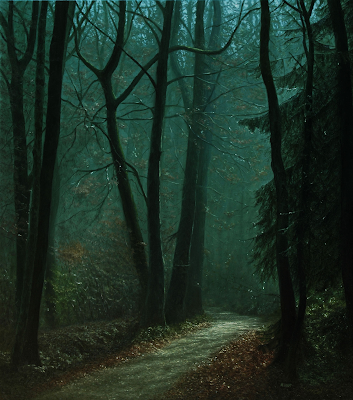 |
| art by Michael Handt |
Rumors
1. Stalmark is the outpost from which the dark lord’s forces send out expeditions. (T)
2. Gilhaven remains free from the dark lord’s influence only in seeming; changeling spies report everything back to the empire. (F)
3. The woods are full of children who serve monstrous plants. Do not trust them! (T)
4. The streams in the Poisoned Wood are deadly to drink from after they pass through the heart of the forest. (T, the result of the pesticides in the Master’s plantation)
5. Deep in the woods, a reclusive estate offers clean water and safety from the hazards of the forest. (T, but only at a cost)
6. The lord of the land retreated to the depths of the forest with a treasure called the Stone of Romra, and calls himself the Master now (T)
Random Encounters on the Road
1. Tom Anguish (see Gilhaven section) and 1d6 porters. -1 reaction but always seems friendly
2. Talkative old man. Offers rumors and good company
3. Team of 2d4 gardeners, led by a hedge knight. Keeping the roadside free of evil vines
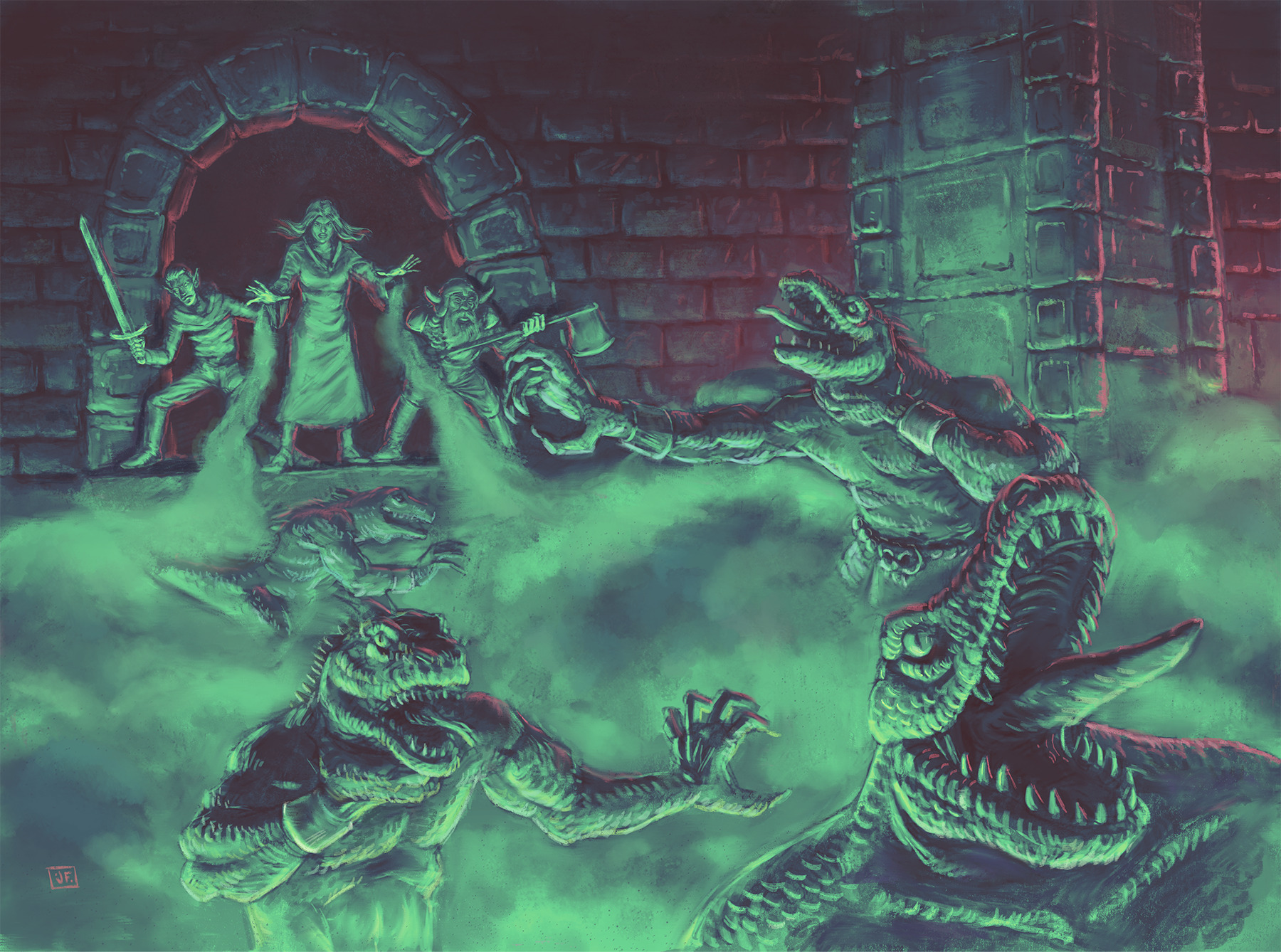
4. Band of 2d6 Granouses (as hobgoblins). Seeking to capture victims and force them to solve riddles, eating a finger or toe for each wrong answer
5. Patrol of 2d4 Imperial Goons (as orcs, with special +1 blistering slingstones that lose their potency in a day)
6. Roll a random encounter from the settled land encounter table.
Random Encounters in the Woods
1. Evangelina (see Stalmark section). +1 reaction
2. Evil Vines (as 3 HD giant leeches)
3. 1d4 children (attempting ambush if reaction roll is hostile)
4. Renthen (see Renthen section)
5. Stream (leads to the Master’s Plantation, 50% chance it’s downstream and therefore deadly poisonous)
6. Roll a random encounter from the forest encounter table.
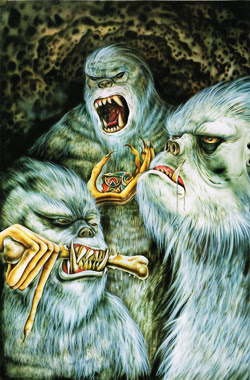 |
| Granouses, by Marc McBrinde |
Hex XXXX- The Poison Woods
Each two hours outside of civilization, there is a 50% chance of an encounter.
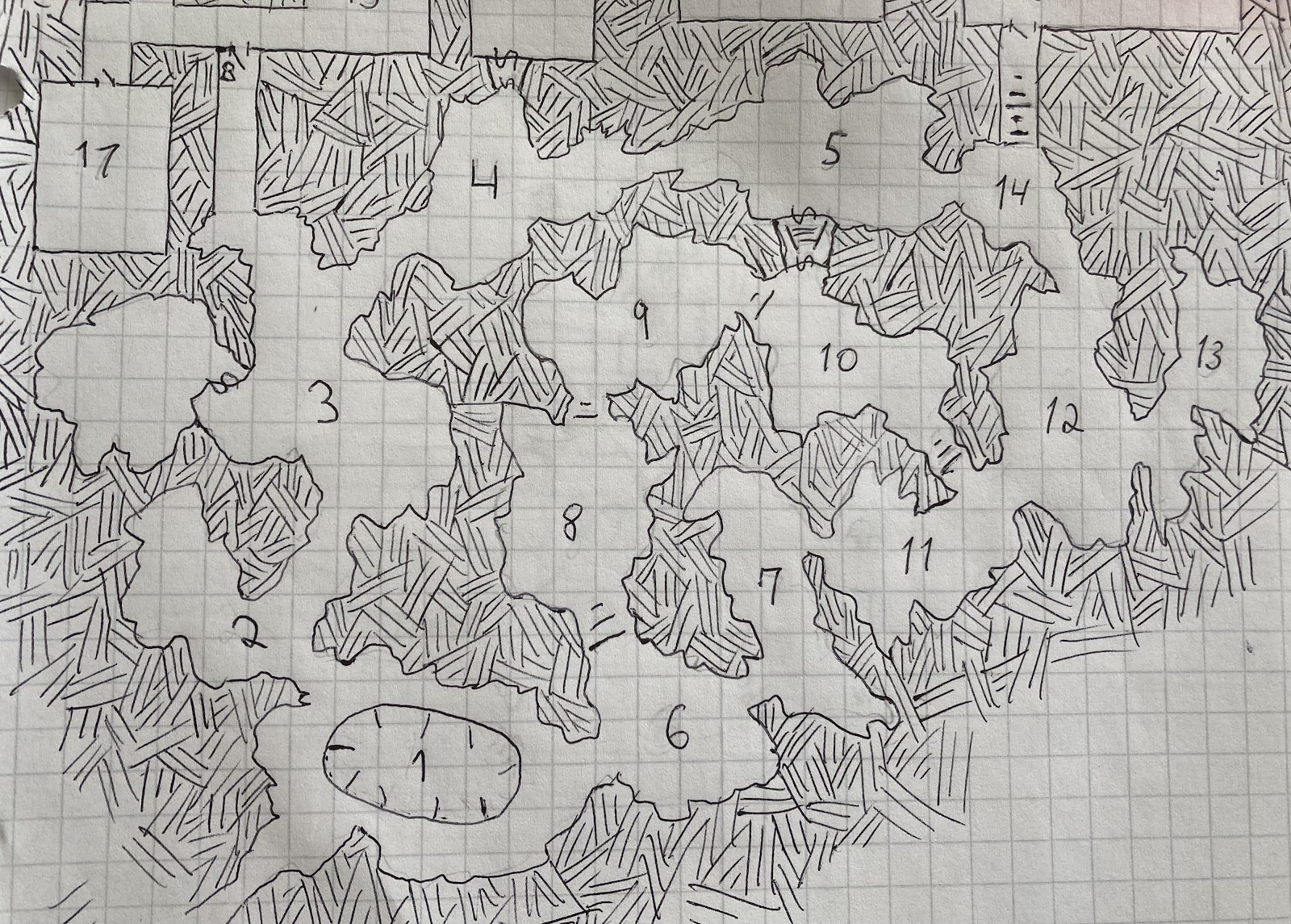
The road running along the edge of this hex splits. One branch leads to Stalmark and the other bypasses to Gilhaven. As a juvenile brain teaser, someone has uprooted the square-faced sign pole that point out which way is which, but a clever child might note that since the different signs point in three directions (Stalmark, Gilhaven, and wherever the PCs are coming from), there’s only one valid way to orient the sign. The same prankster has put the icon of the dark lord on the sign for Gilhaven, though any local could tell you that it’s Stalmark that is allied with the empire.
Stalmark is a town of 2,500 people, ruled by mayor Frederick, who wears a medallion with a left-facing head on it. He’s a coward who’s easy to push around. Imperial goons patrol the heavily-regulated bazaar, and outsiders are pushed around and questioned. PCs who end up here should have a bad time. The sole helpful person is the tavern’s juggler, Evangelina. Treat her as a Thief 3 with a knife penchant. Her daughter was turned into a slug in the woods and she often goes out to visit her. The youngest PC reminds Evangelina of that daughter, so she will take a risk to keep them out of trouble.
Gilhaven is a town of 3,000 people (but no children), ruled by mayor Tomaso, who wears a medallion with a right-facing head on it. He’s a fool who instinctively disbelieves inconvenient things. Suspicious and hysterical citizens patrol the parochial market square, and the outsiders who come to trade where the empire won’t see them are seedy and vulgar. PCs who end up here should have a hard time deciding who to trust. The only devoted servant of the dark lord is an opportunist trader named Tom Anguish. He’ll clock the PCs as subversives he can take in for a bounty pretty quickly, offering them a ride to wherever they're going in his cart before stealing their supplies and coming back with imperial goons or misled mercenaries. If they distrust him, he’ll track their movements and be a constant thorn in their side, such that passing through this hex has a big impact even if they don’t seek the Stone of Romra or enter the Poisoned Wood.
The Poisoned Wood dominates the rest of the hex. Its unique ecology works thus: Renthen preys on runaway children, who help feed the evil vines, which constantly struggle to invade the plantation at the heart of the woods, kept at bay by poison applied by slaves who need to be constantly replaced by the Master.
Renthen is something like a man (stats as bugbear), living with his son in a small steepled building on top of a small hill. He will act like a kind, rustic host, but if he gets someone alone (or if his son gets another child alone), he will lead them to a remote gully, strap them to a slab, and force feed them filth and worms. This magically prevents them from leaving the slab, and they are fed more filth from stone chutes running down into the gully. Sometimes a child’s parents will visit them, unable to break the curse but able to roll food down the chutes to give them some small reprieve. After months, a victim will gradually look more and more like a maggot until they burst into new filth. Buried in Renthen's steeple is a chest with a strange lock, unpickable unless two medallions with face inscriptions are rotation in the front of the chest to face each other. Inside are the souls of 40 children and a spellbook.
Runaway children came from Gilhaven. They believe the Master has a stone that stops the empire from messing with him, and they seek it to protect their families. To achieve this, they’ve somehow made a pact with the Evil Vines of the Poisoned Wood. These kids are vicious. They’ll slash you unprovoked and let the Vines sniff you out. It is conceptually horrible to be stabbed by a murderous child, and remember the people of Gilhaven will ostracize anyone who kills one of their young. The wicked youths congregate in a cave whose opening looks kind of like a horse's head, trading marbles and toys.
Evil Vines are ambulatory plants, with grabbing ropey appendages arranged radially. Sometimes they “walk”, rolling through the woods and keeping their center held high. Evil Vines can smell fresh blood from very far away, showing up 1d3 Turns after any wound incurred outside of a battle with another Evil Vine. Stats at 3 HD Giant Leech, but afraid of fire.
The Master’s plantation of 200 people reeks of chemicals, ringed by dead fume-soaked plants. There is a single bridge of square tiles over the dangerous poison perimeter, with a fence topped with horse-head ornaments and a gate on which is inscribed “Walk ye knight’s path and no evil shall stain you.” If the tiles are traversed as though by a chess knight on a chessboard, they are safe. Otherwise, a wrong step results in the horse ornaments shooting poison darts at the trespasser.
The plantation itself is an irregular polygon of maize fields surrounding the Master’s estate and slavehouses. Stumbling around the fields are slaves in varied states of deteroration as the pesticides they constantly spread take their toll. Each says the Master won their service by beating them in a game of riddles, and some claim that he cheated in their game. Trespassers are treated as prospective hires.
Day-to-day operations are conducted by four members of the Master’s former court:
- wizard Melina (magic-user 5), who is paranoid of spies for the dark lord
- seneschal Randol (thief 3), who mourns and mourns and mourns
- herald Zanzer (cleric 4), who seeks an end to the plantation even if it means serving the dark lord
- Captain Ermen (fighter 4), who has settled into comfortable rum-slicked cynicism
Stored in various places on the plantation are: 2,000 silver coins, 400 gold coins, a platinum puzzle box worth 100 gold coins, a wand of illusory vim, a treasure map to a cache far away, and a music box that summons the ghosts of the recently deceased.
The Master (fighter 13) was made out of a good man. He would be a wizard if he had any numinous quality. He comforts the afflicted, but persists in afflicting them. The slavehouses are well-kept and handsome, and frequent breaks and festivals are mandatory. All he does is done with an air of indulgence, and his twinkling eyes wink from behind his russet beard and unkempt hair. Magical attempts to influence his mind backfire, and arcane attempts to detain him will not be noticed.
When a trespasser is brought before him, the Master will demand a game be played. He will pose a riddle that they must answer to his satisfaction, or else become his slaves. If they succeed, they are allowed to go double or nothing, posing him a riddle. If he comes up short, he will grant them any one favor they wish, offering as examples the Stone of Romra, ownership of the plantation, or his own life.
Good Master-riddles include:
- I have jumped into a cloud. How can this be? He jumped into a pool whose surface reflected the sky.
- I was bitten by a spider with only seven legs. How can this be? He plucked a leg off of a normal spider.
- What is my true name? His intended answer is simply “the Master,” but if the trespassers somehow learned the name he used before becoming the Master he will demurely accept it.
The Stone of Romra, a lump of polished malachite, is incorporated in a diadem he wears when he wants to relive his glory days, and it will be retrieved from his bedchamber’s wardrobe if won. It provides protection like a shield even when unaware of danger, as well as +1 to all saves when worn. Additionally, it prevents other authorities from claiming dominion within three miles of any stronghold you rule.
If the Master is asked to grant a favor that involves surrendering the plantation, he will do so casually. The new owner will morph into him over the course of 1d4 weeks. The same thing will happen if he is asked to grant a favor that involves his death.